Saturday, April 18, 2009

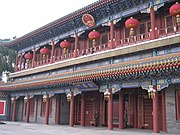
Place of 1989: Xinhuamen (新华门)


Xinhuamen (新华门), or the Gate of New China, is the main entrance of Zhongnanhai, the secretive compound that houses the leadership of both Communist Party and the central government of China.


Just west of Tiananmen Square, Xinhuamen is not a place that attracts a lot of attention. The gate itself was converted from a building when the compound needed an easy access to the Chang'an Avenue outside of its red wall on the south.

The gate is decorated by two giant sloans on each side. The one on the left says "Long Live the Great Chinese Communist Party!" and the other says "Long Live the Victorious Mao Zedong Thought!" The front door of the gate is always open with a pair of soldiers standing guard all the time. Padestrans are always advice to keep their distance.

During the 1989 student movement, Xinhuamen became the focal point in the first nights of protest. As early as April 17, thousands of students gathered in front of the gate to demand an audience with Premier Li Peng. The crowd was finally dispersed in the wee hours of the morning.

But they returned the next evening with even more forces and determination. They actively engaged in a push-and-shove game with the guards for hours. Student leader Wuer Kaixi made his first public appearance that night on the scene and impressed many people with his courage and determination. Police finally broke through the crowd and forced the protesting students into buses. Many people suffered minor injuries during the scuffle. Exagerated accounts of the events were then public displayed as the "April 20 Tragedy" among the many college campuses in Beijing.

A month later, Xinhuamen also became a site of hunger strike when a group of teachers and students from University of Political Science and Law broke from their main camp in Tiananmen Square and staged their own hunger strike here. They effectively shut down this entrance for weeks.
During the day of June 3, a van carrying military weapons was discovered on Chang'an Avenue just outside of Xinhuamen. Students ceased the vehicle and displayed the guns on its tops. Around noon, police charged the crowd with tear gas and recovered the weapons. It was the first time tear gas was used.

Pictures of 1989

Selected pictures of the 1989 Chinese Student Movement

Pictures of 1989: Mourning Hu Yaobang

At the base of the Monument to People's Heroes:


At The Triangle of Peking University:


At Beijing Normal University:


Students from Peking University delivering the "China's Soul" banner to Tiananmen Square: (The characters for "China's Soul" are in the center of the banner and invisible from this photograph.)

This Day in 1989: April 18, Students Sit-in at Great Hall of People and Xinhuamen

After spending the night in Tiananmen Square guarding the flowers and wreaths at the Monument to People's Heroes, the crowd from Peking University shrank to about two hundreds in the early morning of April 18, 1989. They had come up with a Seven-Point Petition which they intended to submit to the National People's Congress.

Wang Dan and Guo Haifeng led the remaining crowd onto the steps of the Great Hall of People. When it opened the door in the morning, they went in and submitted the petition to an office. Wang Dan obtained a receipt and then left the scene. But the crowd was not satisfied and remained at the site. They wanted to have People's Representatives to receive the petition in person. Another copy of the peitition was made and Li Jinjin took the lead to organize a day-long sit-in. It was by the evening hour when three People's Representatives finally agreed to appear and receive the petition in front of the students. Li Jinjin met them on the steps and handed the paper in a scene resembling a formal diplomatic manuver.

Li Jinjin left the scene and returned to Peking University, where to his horror he saw large groups of students rushing out of the campus to reinforce the crowd at Tiananmen.

Later that night, a sizable crowd gathered in front of Xinhuamen, the site of the central government and engaged a push-and-shove match with the guards there. They demanded for the Premier Li Peng to appear in person for a dialogue. The situation was tense.

Eventually, however, the crowd dispersed in the early morning hours with the combined efforts of rational persuasion and the appearrance of more and more police force. No violence broke out that night, but the same could not be said for the next night.


Days of 1989

Documents of 1989

Significant Documents of 1989, with more to come.
  1. Fang Lizhi's Open Letter, January 6, 1989
  2. China's Despair and China's Hope, Fang Lizhi, February 2, 1989
  3. 33 Writers' Open Letter, February 13, 1989
  4. 42 Scientists and Educators' Open Letter, February 26, 1989
  5. 43 Intellectuals' Open Letter to NPC, March 14, 1989
  6. Hu Yaobang's Obituary, April 15, 1989
  7. Seven-Point Peitition, April 18, 1989
  8. Chen Mingyuan's Speech at Peking University, April 23, 1989
  9. People's Daily Editorial, April 26, 1989
  10. Hunger Strike Manifesto, May 13, 1989
  11. The Making of Statue of Democracy, May, 1989
  12. Four Gentlemen Hunger Strike Manifesto, June 2, 1989
  13. Radio Beijing Broadcast, June 4, 1989
  14. 21 Most Wanted Student Leaders, June 13, 1989
  15. President Bush's Secret Letter to Deng Xiaoping, June 20, 1989
  16. Catch Liu Xiaobo's Black Hand, June 24, 1989
  17. President Bush's Diaries, June-July, 1989

Document of 1989: Seven-Point Petition


In the early morning of April 18, 1989, hundreds of students from Peking University gathered around the Monument to People's Heroes at Tiananmen Square. They had spent the previous night there guarding the wreaths and flowers dedicated to the newly deceased Hu Yaobang. Wang Dan, Guo Haifeng, Li Jinjin, and Zhang Boli were all among the crowd. They proposed to draft a formal petition to the government.

After much discussion, a "Seven-Point Petition" was drafted:
  1. Reevaluate and praise Hu Yaobang's contributions
  2. Negate the previous anti-"spiritual pollution" and anti-"Bourgeois Liberation" movements
  3. Allow unofficial press and freedom of speech
  4. Publish government leaders' income and holdings
  5. Abolish the "Beijing Ten-Points" [restricting public assembly and demonstrations]
  6. Increase education funding and enhance the compensation for intellectuals
  7. Report this movement faithfully
The petition was first written as big posters. Wang Dan and Li Jinjin made separate attempts to submit them to People's Representatives in the Great Hall of People that day. The list was also widely circulated among the campuses in Beijing and became the focal point in the early stages of the student movement. The government never responded directly to the petition.

On April 22, at the end of the state funeral for Hu Yaobang, three students made the most dramatic scene of kneeling down at the steps of the Great Hall of People and lifting a copy of the Seven-Point Petition over their head.


Documents of 1989


Friday, April 17, 2009

Li Lu Appears in Fortune Report

Li Lu, one of the key leaders in the 1989 student movement, has been largely staying out of the media limelight in more recent years. He made a rare appearance in the April 27 issue of Fortune magazine in a report on Warren Buffet's investment in electric cars made in China. In the print version, the magazine also contains a box segment introducing Li Lu:
Warren Buffet may be BYD's most famous investor, but Li Lu, whose company LL Investment Partners owns 2% of BYD, has quite a story of his own. Born in China in 1966, Li Lu was raised by foster parents after his were forced into labor camps during the Cultural Revolution. As a 10-year-old, he barely survived an earthquake that killed 250,000 in the city of Tangshan. Then things got really interesting: Li Lu became a leader of the pro-democracy movement that organized protests in Tiananmen Square in 1989, appeared on China's Twenty-One Most-Wanted List, and escaped to New York, where he was embraced by the human-rights community and earned three degrees from Columbia. After stints at Allen & Co. and DLJ, he met Charlie Munger through friends and started his own investment fund; Munger, the Berkshire vice chairman, is his largest investor. Li Lu, who is not allowed to travel freely in China, politely declined to be interviewed by Fortune. When asked about Li Lu's story, BYD CEO Wang Chuan-Fu says: "That's past history. Today, Mr. Li and I share the belief that the best way to help China move forward is to make BYD a world-class company."