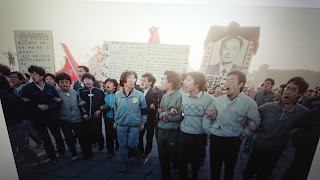
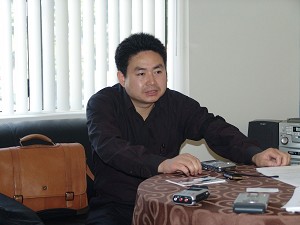
Showing posts with label Zhou Yongjun (周勇军). Show all posts

Friday, August 11, 2017

People of 1989: Yu Zhijian (余志坚)

Born in 1963, Yu Zhijian had graduated from a teaching college in Hunan for five years by 1989. He was initially given jobs teaching at local elementary and middle schools. But he soon grew tired of it and resigned in 1988. In his own words, he spent most of this time with his best friends Lu Decheng and Yu Dongyue, enjoying a free lifestyle.

With the breakout of the 1989 student movement, the three started to display banners and make speeches in a couple of cities in Hunan province. By mid May, they decided to go to Beijing and arrived there on May 18.

On May 23, with the movement stalled after two days of martial law, they decided to do something dramatic. In that afternoon, the three came under the Tiananmen and threw egg shells filled with paint onto the giant portrait of Mao Zedong, defacing it.

It happened at the time when most student leaders were off the square at a strategic meeting. The remaining student picket team arrested the three. After a brief discussion, Zhou Yongjun and Guo Haifeng decided to hand them to the government, fearing for lending the government excuse to suppress the movement.

After the massare, Yu Zhijian received a life sentence (Yu Dongyue got 20 years and Lu Decheng 16). After eleven and half years of prison, Yu Zhijian was released early for medical reason. He managed to escape from China into Tailand in 2009 and arrived in US. With a political refugee status, he lived with his family in Indiana. They also have been taking care of Yu Dongyue, who had become mentally incapacitated by the experience.

Yu Zhijaing (right) with his wife and son.

Yu Zhijian died on March 30, 2017, of diebetes. He was 54.


Friday, July 3, 2015

Days of 1989: June 11, Xiao Bin Arrested, Zhou Yongjun Turned himself in, Fang Lizhi Wanted

On June 11, 1989, Beijing Public Security Bureau officially published the Most Wanted notice on Fang Lizhi and Li Shuxian. The two of them had already taken refuge in the American embassy at the time.

Zhou Yongjun, on the other hand, chose to turn himself in on this day.

Also arrested on this day is a man by the name of Xiao Bin. On June 4, he was caught on the camera of American TV news exaggerating the scenes of the massacre. He was later sentenced to 10 years prison term.

In Paris, 17-year-old American Chinese tennis player Michael Chang won the French Open. He spoke on God bless Chinese people.


Days of 1989

Sunday, May 10, 2015

Pictures of 1989: Students Bicycle Rally on May 10, 1989

Students from Peking University start their rally.

Zhou Yongjun, Wang Dan, Wang Chaohua, and Zheng Xuguang (from left to right) join the rally.

Pu Zhiqiang in the rally, calling for press freedom.

Students in bicycle rally.

Students rally through Chang'an Avenue. (Photo by Philip Cunningham)

Students rally through Chang'an Avenue. (Photo by Philip Cunningham)

Students from Beijing Normal University at Chang'an Avenue. (Photo by Philip Cunningham)

Students rally at Tiananmen Square.

Students rally at Tiananmen Square.

Students protest in front of People's Daily, Chai Ling is speaking.

Students protest in front of People's Daily. (Photo by Philip Cunningham)


Pictures of 1989

Wednesday, April 22, 2015

Pictures of 1989: Students Participate Funeral at Tiananmen on April 22, 2015

Students from the University of Politics and Law enters Tiananmen Square.
Students from the University of Politics and Law. The tall one by the red flag in back row is Pu Zhiqiang. The one wearing a black sleeve band in front is Wu Renhua.

Students sit down in front of the Great Hall of People waiting for the funeral, under the watchful eyes of police.

Students from Tsinghua University wait for the funeral.

Students waiting for the funeral

Students from University of Politics and Law sing patriotic songs.

Students in the Square observe a moment of silence at the start of the funeral.

At the funeral inside of the Great Hall of People, leaders pay last respect to Hu Yaobang's body.

Students Zhang Zhiyong, Guo Haifeng, and Zhou Yongjun (from left to right) kneel down with their petition.

Other students persuade the kneeling three to give up the petition. 


Pictures of 1989


Saturday, April 18, 2015

Pictures of 1989: Tiananmen and Xinhuamen on April 19, 1989

A giant portrait of Hu Yaobang is installed at Monument of People's Heroes

Zhou Yongjun delivers a speech at Xinhuamen

Protesting crowd at Xinhuamen

Pictures of 1989

Thursday, November 24, 2011

People of 1989: Li Jinjin (李进进)


On April 18, 1989, three days after the death of Hu Yaobang, Li Jinjin found himself sitting on the stairs of the Great Hall of People at Tiananmen Square among younger students trying to petition their government. He was excited but not quite ready to act himself.

At the time, Li Jinjin was a graduate student of law at Peking University. Unlike most of his classmates there, he had already acquired quite a bit of experiences outside of campus.

Born in 1955, he grew up in the midst of the Cultural Revolution when the education system was disfunctional at the best. When he was only 15, he joined the People's Liberation Army (with his age altered by a recruiting officer). Six years later, he was discharged and became a policeman at his hometown Wuhan city. That was the time when the national college entrance exam was reinstated and he became one of the hundreds of thousands youngsters fighting for a precious spot in higher education. In 1978, he became an undergraduate student of law near his hometown at the age of 23.

He then became a graduate student in Peking University in 1982 and graduated with a masters degree in 1985. After a couple of years of teaching, he returned to Peking University in 1987 to pursue a Ph.D. in law. During his second stinct there, he became active and campaigned to become the chairman of the school's Graduate Student Association in 1988. But he soon got into trouble by publicly voicing dissents and organizing controversial seminars. In early 1989, he was replaced in a reelection meeting that he himself was not aware of.

Having been cautioned to stay out of trouble, Li Jinjin had decided to focus on his academics in that spring of 1989. But when he observed the faltering sit-in at Great Hall of People, he nonetheless stepped up and took a leadership role. He led the latter stage of the day-long sit-in and achieved success: publicly and peacefully submitting students' Seven Point Petition to three People's Representatives. He left the scene immediately afterwards. But the crowd did not disperse and marched to the site of the government instead. It later led to quasi-violent confrontations with police at Xinhuamen.

That could have become the single odd apperance for him in the movement as he immediately disappeared. In early May, he even left Beijing to get back to his family in Wuhan due to their concerns of his involvement. It was not until May 18, when the hunger strike had greatly escalated the confrontation in the streets and a crackdown was immenient, that he got himself involved again. But this time, he took a different route.


On May 18, 1989, Li Jinjin was back on the streets of Beijing, delivering improptu speeches. That night, he happened upon a couple of workers who were trying to organize workers. He volunteered his service and immediately became the de-facto legal counsel of the budding Workers Autonomous Federation. Along with Han Dongfang and Zhou Yongjun, etc., he helped to launch the organization and drafted many of its documents and public statements.

When several members of the federation were detained on May 31 as a precursor of the coming crackdown, Li Jinjin and Han Dongfang led a group of workers and students in another day-long sit-in at Beijing police headquarters. They eventually won the release of their detained members.

Quite amazingly, Li Jinjin then left Tiananmen Square on June 2 and returned to Peking University for his Ph.D. qualification exam. In the morning of June 3, he successfully passed the exam and was spending the rest of day preparing documents to formally register the federation when news of massacre altered all his planning. He tried to return to the Square that night but didn't get past Muxudi, scene of the bloodiest battle that night.

After the massacre, Li Jinjin left Beijing and returned to his home in Wuhan, where he was arrested on June 10, 1989. He was released without a formal indictment on April 24, 1991. He travelled to US in 1993 and earned his US law degrees. He is now practicing law in the state of New York and active in the oversea Chinese democracy movement.

In June, 2011, Li Jinjin published his memoir, documenting his experience in 1989 and the subsequent prison life in China.


Thursday, January 13, 2011

HKJ: The Strange Case of Zhou Yongjun

Thomas E. Kellogg at the Hong Kong Journal investigated the recent case of Zhou Yongjun, one of the prominent student leaders of the 1989 movement, that led to him being jailed in China for charges of bank fraud:

THE STRANGE CASE OF ZHOU YONGJUN
By Thomas E. Kellogg
January 2011

On the morning of September 28, 2008, a middle-aged ethnic Chinese man of seemingly unknown national origin and identity arrived in Hong Kong. Traveling on a false Malaysian passport under the name Wang Xingxiang, this man, when confronted, refused to state his real name. The other items in his possession – including bank cards and credit cards – also bore the name Wang Xingxiang; there was nothing else on his person that could establish his true identity.

This man was questioned by Immigration authorities, who were unable to wrestle his name or virtually any other information from him. He was also interviewed by the Hong Kong police, who apparently suspected him of involvement in attempted bank fraud. On the evening of October 1, this man was transferred from Hong Kong to Shenzhen. He was then held incommunicado in Shenzhen for seven months, after which time he was transferred to Suining City in Sichuan Province. It was only in May 2009 that it became publicly known that this man, whose real name is Zhou Yongjun, was in fact in Chinese custody. In November 2009, Zhou was tried by a court in Sichuan province for bank fraud, and sentenced to nine years in jail in January 2010. He remains in jail in Sichuan to this day.

The case of Zhou Yongjun is a strange one. Zhou, a student activist in Tiananmen Square, spent roughly 18 months in detention for his involvement in the 1989 student protests. After his release, Zhou fled China, and sought and received political asylum in the United States. Around 2002, he became involved with the exile spiritual leader Zhang Hongbao, the founder of the Qigong group Zhong Gong—not related to the better-known Falung Gong. Many have speculated that Zhou’s ties to both overseas democracy activists and exile Qigong groups heightened the Chinese government’s interest in him, and that these ties are very much related to his transfer from Hong Kong to China.

The murkiness of his case, and, more recently, revelations which have heightened suspicions that he was in fact involved in bank fraud, have obscured the very real concerns over Hong Kong’s autonomy and the integrity of “one country, two systems” that are raised by his treatment in Hong Kong. During his roughly four days in Hong Kong, Hong Kong authorities took decisions on his case that, while apparently not illegal, are nonetheless inconsistent with established practice. Since Zhou’s detention in Guangdong has become known, the Hong Kong SAR government has repeatedly refused to provide information on its handling of the case, instead resorting to bland restatements of government immigration policy and blanket refusals to comment on individual cases.

The Zhou Yongjun case is the first of its kind. As far as is known, since the 1997 handover, the Hong Kong government has never been involved in handing over to Chinese authorities an exile activist who could reasonably fear persecution based on prior political activism. The government’s handling of the case needs to be seen in the context of recent cases of seemingly political decisions by Hong Kong Immigration, to keep various persons, many of them exile dissidents and political activists, from entering Hong Kong. 1Troublingly, the Zhou Yongjun case seems to have taken that process one step further.

Since the initial public disclosure of Zhou’s detention in Sichuan, significant circumstantial evidence has emerged that suggest that Zhou may well have attempted to enter Hong Kong in order to engage in bank fraud. Yet the possibility that Zhou may well have had nefarious ends in mind does not exonerate the SAR government, if indeed political considerations or inappropriate contacts with mainland authorities played a role in its deviations from standard practice in Zhou’s case. The protections offered by the rule of law and Hong Kong’s autonomy under the one country, two systems formula exist not just for the innocent but also for the guilty.

Who is Zhou Yongjun?

A native of Pengxi County in Sichuan Province, Zhou Yongjun, now 43, was a student majoring in political science at China University of Political Science and Law when the student protests broke out in the Spring of 1989. Zhou was a sometime leader of the student protests. His claim to fame was that he was one of three students to kneel on the steps of the Great Hall of the People in an attempt to present a petition of student demands to senior Party leaders on the day of Hu Yaobang’s funeral, April 22, 1989. The protests were forcibly quashed by the government in the early morning hours of June 4, 1989. Zhou was detained in mid-June, and held for over a year without trial. He was released in January 1991. 2 Zhou fled China in June 1992, and arrived in the United States in February 1993.

Zhou’s first incarnation in the United States was as exile political activist, a not-uncommon role for Chinese who ended up in the United States or Europe after the Tiananmen Square protests. For the next few years, Zhou remained active in exile politics, based mostly in New York.

In December 1998, Zhou attempted to sneak back into the mainland and was detained in Guangzhou. After being held in Guangzhou for six months, Zhou was transferred to Sichuan, where he was sentenced to three years of reeducation through labor, a form of administrative detention most often used in China to deal with petty crimes. He was released in 2002, and allowed to return to the United States soon after his release.

It was after his return to the United States that Zhou’s story begins to intersect with that of Zhang Hongbao. And it may be that connection, even more than his 1989 student activism, that led Zhou to Hong Kong in 2008, and also led the Chinese government to take a stronger interest in him.

Zhang Hongbao was one of the first charismatic Qigong masters to emerge at the onset of China’s Qigong boom in the mid-1980s. He created his own form of Qigong, which he called Zhong Gong – a Chinese abbreviation of the full name, which means Chinese Qigong to Nourish Life and Increase Intelligence – and lectured on its precepts to ever-larger audiences in Beijing throughout the second half of the 1980s. 3By 1990, Zhang had achieved a certain level of fame: a 1990 biography, emphasizing his spiritual powers and teachings, sold more than ten million copies.

Zhang was determined to turn his public profile and army of devoted followers into a revenue machine. In the words of David Ownby, a leading Western expert on Qigong in China, Zhang was “the Donald Trump of the Qigong world.” 4 In the early 1990s, Zhang set up a nationwide network of Zhong Gong centers, which engaged in both Qigong training and practice, and the selling of related products, including writings and recordings on Qigong, medicine, and tea. His followers numbered in the millions, and the nationwide pyramidal scheme he set up ensured a large and steady stream of revenue into his coffers. Zhang was also careful to cultivate good relationships with Communist Party officials, and, at that time at least, expressed no interest in any sort of political agenda.

“It was a real moneymaking thing,” said Ownby, who teaches at the University of Montreal. “He applied a marketing logic pretty much from the beginning.” 5

Zhang’s Zhong Gong was by no means the only game in town: hundreds of other Qigong masters, many of them heading their own organizations, vied for followers alongside Zhong Gong. The most famous of these was Falun Gong, headed by the controversial spiritual leader Li Hongzhi. Whereas Zhong Gong was highly centralized and profit-driven, Falun Gong, especially in its early years, was highly decentralized. It focused less on money – there were no formal admission fees, and anyone could join – and more on the spiritual side of Qigong. 6 Its membership skyrocketed after its founding in 1992, and its tens of millions of adherents included not just average Chinese but also close relatives of senior central government officials.

The Party Grows Wary

Such rapid growth could not but catch the eye of wary Communist Party officials, and many within the Party urged vigilance against what they saw as an emerging threat. “Over time, there were detractors,” said Ownby. “There were people who thought this was getting out of hand.”

Friction between the Party and Qigong groups increased throughout the 1990s. Li Hongzhi left China in 1995, after hearing rumblings of discontent in official circles over his activities. Media attacks on Falun Gong in particular became a regular occurrence after that. In June 1996, for example, the Guangming Daily published a piece calling Li a “swindler” and referring to the groups practices as “feudal superstition.” 7Dozens of similar pieces followed in newspapers across the country.

Falun Gong adherents did not take these public attacks lying down, and tensions between the two sides continued to escalate. The famous protest staged by thousands of Falun Gong followers in front of Zhongnanhai, the seat of China’s government, in April 1999, was only the largest of a series of demonstrations. As it turned out, it was also the straw the broke the camel’s back: any lingering sympathy that Falun Gong may have had within the government evaporated, and the government moved to suppress the group.

The ensuing crackdown by the government swept up not only Falun Gong but also other Qigong groups, including Zhong Gong. Travelling under an assumed name, Zhang fled China in 1994, turning up in Guam in July 2000. He claimed political asylum, and came to the United States soon thereafter. 8 He seems to have brought at least some of the fortune he amassed in China during the 1990s with him.

It is not known exactly when Zhang Hongbao and Zhou Yongjun connected for the first time in exile, or why Zhou, an exile political activist, wanted to get in touch with a quasi-spiritual figure like Zhang. In court documents filed after Zhang’s death, Zhou indicated that he moved to California to work with Zhang in January 2003, identifying himself as a “special adviser and assistant.” 9

Whatever the timing of the initial contact and the reasons behind it, Zhou’s integration into Zhang’s exile Zhong Gong world seems to have been quite extensive. Zhou described Zhang as “my master, mentor and fatherly friend,” and recalled their hours-long daily conversations. 10 “We were very close,” Zhou wrote. Life in Zhang Hongbao’s exile world was not for the faint of heart: Zhang fought bitterly with his estranged former second-in-command Yan Qingyan, and he continued to be dogged by allegations of violent illegal behavior. In 2003, Zhang was charged with assaulting his housekeeper, He Nanfang; he later pleaded no contest to a lesser charge. 11Yet despite all of the turbulence, Zhou stayed by Zhang’s side. When Zhang was killed in a car accident in Arizona in July 2006, it was Zhou who spoke at a hastily-arranged press conference, seeming to imply foul play in Zhang’s death.

Zhou was also a party to the dispute over the rather large estate that Zhang left behind. At the time of his death, Zhang’s holdings included real estate and cash, some of it in bank accounts in several different countries. 12 Zhou’s decision to travel to Hong Kong took place against a backdrop of the increasingly acrimonious and high-stakes fight over all that Zhang had left behind.

It is the legal documents stemming from the fight over Zhang’s estate – as well as the paper trail from prior litigation involving Zhang, Zhou, Yan and others in the exile Zhong Gong circle – which most strongly indicate that Zhou could not have been ignorant of the significance of the name Wang Xingxiang.

Wang Xingxiang is the alias that Zhang Hongbao used when he left China in the mid-1990s. He continued to use that name on various bank accounts that held funds that he had amassed while still in China. Wang Xingxiang is openly identified as Zhang’s alias in several court documents, including on some documents in litigation to which Zhou was a party. And that same name appears on the Hong Kong bank accounts that, many believe, Zhou traveled to Hong Kong to access.

Zhou Yongjun’s Hong Kong Sojourn

On September 26, 2008, Zhou left his home in California for Asia. He told his girlfriend, Zhang Yuewei, with whom he had a six-month-old daughter, very little about his plans; after his arrest and detention in China became known, Zhang Yuewei publicly claimed that Zhang was in Hong Kong en route to Sichuan to visit his parents. 13

On September 28, Zhou arrived in Hong Kong from Macau. His false passport, bearing the name Wang Xingxiang, was uncovered, and he was taken into custody by Hong Kong Immigration officials. During his time in custody, Zhou was questioned by the Hong Kong police over a case of alleged bank fraud involving bank accounts in Hong Kong under the name Wang Xingxiang. The questioning by Hong Kong police took place both in an immigration office at the Hong Kong Macau Ferry Terminal and at a Hong Kong Police Department office.

The bank fraud inquiry related to attempts to extract funds from various bank accounts, both in Hong Kong and elsewhere, in the name of Wang Xingxiang, which, as noted above, was an alias of Zhang Hongbao. In May 2008, roughly four months before Zhou Yongjun’s arrival in Hong Kong, an individual claiming to be Wang Xingxiang sent fax transmissions bearing an address in Canada to a Citibank branch in Hong Kong, requesting transfer of two million Hong Kong dollars (roughly $250,000 by current exchange rates) to an account in British Columbia, Canada. 14Zhou’s entry into Hong Kong on a passport bearing the same name at least facially connected him to the case. 15

According to Zhou’s account of his time in custody, one of the Hong Kong police officers who had interrogated him informed him by phone in the evening of October 1 that he would not be prosecuted and that he would be released. Zhou, who had been transferred to a hospital for medical treatment, was asked to return to the Hong Kong Macau Ferry Terminal police station immediately. “Our investigation is over and we will not file any charges against you,” Zhou says the officer told him. “We let you go right away. Can you stop waiting there for the medicine and come back as soon as possible?” 16

At a few minutes after 8pm on October 1, again according to Zhou’s account, Zhou was put in a minibus with seven or eight men who, he was told, were Hong Kong Immigration officials. He apparently thought he would be driven from the Ferry Terminal police station to the ferry itself, but it soon became clear that they were headed to another destination entirely. Zhou claims that he was driven for roughly thirty minutes up through the New Territories into Shenzhen, after which time the car stopped and he was handed over to a group of mainland officials. Zhou’s time in Hong Kong had come to an end

At the very least, Zhou’s treatment by Chinese authorities after his return highlights the potential dangers of returning persons with sensitive political backgrounds to the mainland. Once Zhou was handed over to Chinese authorities, his rights were repeatedly violated. Although he openly disclosed his actual identity to his Shenzhen jailers very early in his confinement there, he was nonetheless given no access to an attorney or to members of his family. 17 In violation of Chinese law, he was held in incommunicado detention in Shenzhen under the name Wang Hua for seven months. Zhou’s US-based lawyer, Li Jinjin, has alleged that Zhou was tortured by Chinese authorities while in custody in Shenzhen.

It was only after he was transferred to a detention center in Suining City in Sichuan in May 2009 that the authorities formally acknowledged custody of Zhou, initiated the criminal process and allowed him some access to an attorney and family members. Both the investigation of Zhou’s case and his subsequent trial were marred by procedural violations all too common to “political” cases in China.

Analysis: Questionable Moves on Both Sides
There are many aspects of Zhou’s case which raise serious questions. First and foremost, if it was clear that Zhou had traveled into Hong Kong on a false passport, why did Hong Kong authorities choose not to prosecute him for passport fraud? According to several Hong Kong immigration lawyers, it is standard practice for the Hong Kong SAR government to prosecute individuals who show up in Hong Kong using false documents, in order to discourage others from doing so.

“This man’s case is unusual,” said Philip Dykes, a leading Hong Kong lawyer and human rights advocate. In a case like this, Dykes suggested, “you would have expected a prosecution.” 18

“They always prosecute,” another lawyer with extensive experience in immigration cases said, noting that the minimum sentence in such cases is usually eighteen months.

Yet, in Zhou’s case, the Hong Kong authorities declined to prosecute. As senior Hong Kong officials have pointed out after Zhou’s case came to light, the power to prosecute for passport fraud is in fact discretionary, 19 and it must be said that no violation of Hong Kong law has emerged in the SAR’s handling of Zhou’s case. But why did the SAR government depart from standard operating procedure in its handling of Zhou’s case? Would not the evidence linking Zhou to bank fraud – discussed in more detail below – strengthen, rather than weaken, the argument in favor of prosecution?

Many observers, Zhou’s lawyers among them, have questioned why Hong Kong Immigration chose to return Zhou to the mainland, rather than Macau, where he had come from, or the United States, his place of residence. Others, including Legislative Councillors Margaret Ng and Leung Kwok-hung, also known as Long Hair, have asked whether Immigration officials informed Zhou that he would be returned to the mainland, and obtained his consent to return. 20 As of this writing, the SAR government has not made clear whether Zhou was told that he was being returned to the mainland; it has generally declined to comment on the specifics of Zhou’s case.

It should be noted that there are one or two key discrepancies between Zhou’s own account of his time in Hong Kong and the story told by the relevant Hong Kong Immigration documents. Most crucially, Zhou suggests that he never revealed his name or the fact that he is originally from mainland China. The Immigration Department’s Record of Interview for Zhou, which begins at 11.12pm on September 30, and ends at 1am on the morning of October 1, does not suggest that Zhou revealed his identity, but it does state that he initially informed immigration officials of his actual place of birth, Sichuan province. Other immigration forms generated by Hong Kong Immigration also state that Zhou identified his place of birth as Sichuan, and that this was the basis for Zhou’s removal to the Mainland. 21

If true, this would suggest a more solid factual basis for the Hong Kong government’s decision to return Zhou to the mainland than has previously emerged. As many have pointed out, standard practice would be to return an individual either to his place of residence or his place of origin. If Zhou’s current place of residence was genuinely unknown, then it would make sense to return him to the mainland.

Yet while certain moves by the Hong Kong authorities deserve further scrutiny, Zhou himself also made choices that are difficult to understand. For example, Zhou’s decision not to reveal his actual identity remains a curious one. If, as his own account of his return to the mainland suggests, he began to suspect that he was being transported back to China, why did he not disclose his actual identity, and request deportation to the United States, his place of residence? Surely doing so would have made it much more difficult for Hong Kong immigration officials to send him back to China. It is at least possible that Zhou thought he could ride the entire episode out by keeping his mouth shut; he may have believed that, once the Hong Kong authorities tired of him, he would be put on a plane back to California. Yet doubt must have crept into his mind as he was being driven northward. Zhou’s silence as he was being driven to Shenzhen remains one of the key unanswered questions of the affair, one that begs elaboration by Zhou himself.

The Hong Kong Immigration file on Zhou’s case also casts further doubt on Zhou’s claim that he was unaware of Zhang’s use of the alias Wang Xingxiang, and also provides some circumstantial evidence connecting Zhou to the case of bank fraud for which he was tried and convicted. According to Hong Kong Immigration documents, Zhou was carrying a various credit and bank cards in the name of Wang Xingxiang; it is unlikely that someone who picked up a false passport with, as Zhou claims, a randomly-assigned name, would also go through the trouble of having bank cards created in that same name. Zhou was also carrying a business card of Zhang Hongbao’s, which, one assumes, Zhou would not have wanted to carry into the mainland with him for security reasons. Also, the date of birth listed on Zhou’s fake Malaysian passport, August 8, 1953, corresponds with the date of birth on Zhang Hongbao’s fake mainland Chinese ID card in the name of Wang Xingxiang. 22

These additional facts, when combined with revelations first uncovered by the South China Morning Post about Zhou’s extensive connections with Zhang, further undermine the credibility of Zhou’s claim that he did not know that Zhang Hongbao used Wang Xingxiang as an alias, and that he was given the fake Malaysian passport in that name at random. In sum, it is difficult to believe that it could have been a (for Zhou) unlucky coincidence. One is left to wonder: if it is in fact the case that Zhou obtained a forged passport in the name of Wang Xingxiang, why did he do so?

And yet, as more and more circumstantial evidence mounts of Zhou’s involvement in attempted bank fraud comes to light, the Hong Kong authorities’ decision to return him to the mainland becomes even more difficult to understand. If, as seems to be the case, the Hong Kong police had in their possession evidence that strongly suggested Zhou’s intent to engage in illegal activity in Hong Kong, why did they not prosecute him? At the very least, why not begin prosecution for his use of a false passport, a seeming open-and-shut case, and continue to investigate Zhou’s possible involvement in bank fraud?

What Next?

Even if one views the facts of Zhou’s case as suggestive of foul play on the part of Zhou, its outcome is nonetheless troubling. Zhou was held for months in incommunicado detention, and was denied a fair trial. His ability to speak on his own behalf, and to shed light on some of the more perplexing aspects of his case, is limited. Perhaps most importantly, his girlfriend and young daughter have no access to him in China.

What, if anything, can be done? Options are severely limited. When appropriate, the US will arrange for US citizens convicted of crimes in foreign countries to serve their sentence in the United States. Such transfers can only take place with the consent of the prisoner him or herself, and do not include the right to a new trial in America. In fact, reconsideration of the original verdict, no matter how flawed, is generally off the table.

Such an option would be an attractive one for Zhou: it would get him out of China, and would allow him to serve his sentence in a place where his girlfriend and daughter could have at least some contact with him. Yet for Zhou, prisoner transfer is not possible: he is only a green card holder, not a US citizen, and is therefore not eligible for prisoner transfer. Also, although Hong Kong does have a prisoner transfer agreement with the US, China does not. 23

In sum, Zhou’s legal options are virtually non-existent. The only option left may be political: the only way that progress might be made on Zhou’s case is if international human rights groups and foreign governments intervene on his behalf, making the case with Beijing for an early release. Yet this option too is problematic: especially since the link between Zhou and alleged bank fraud has become more pronounced, the voices calling for action on his case, never particularly strong, have grown even quieter.

It is likely that the lack of action around his case has everything to do with the lack of clarity surrounding the allegations of impropriety by Zhou. To this day, Zhou Yongjun has maintained his innocence, claiming, however improbably, that he ended up with a passport in the (false) name of his former patron completely by accident and without his knowledge. As Zhou endures his third year behind bars in China, one wonders whether he might want to consider a different approach: if he decides to fully and publicly explain his reasons for traveling to Hong Kong, might not his act of painful honesty generate a bit more sympathy for him, such that international actors in a position to weigh in on his case with Beijing might be more inclined to do so? A slim reed, to be sure, but at this point where else can Zhou pin his hopes?

Thomas E. Kellogg is program director and advisor to the president of the Open Society Institute. He is also adjunct professor of law at the Fordham Law School.

1. For more on seemingly political decisions by Hong Kong Immigration related to entry into Hong Kong, see Thomas E. Kellogg, “Stirring Up Trouble: the Johannes Chan Incident, Ideological Exclusion and Immigration Law in Hong Kong and Macau,” Hong Kong Journal, July 2009.

2. Lena H. Sun, “Chinese Activists Sentenced; Student Leader Wang Given 4-Year Term,” Washington Post, January 27, 1991.

3. David Ownby, Falun Gong and the Future of China, Oxford University Press, 2008, p. 71. For a very good short summary of Zhang’s rise and fall in China, see Ownby, pp. 70-77. See also David Palmer, Qigong Fever: Body, Science, and Utopia in China, Columbia University Press, 2007, pp. 146-150.

4. Author interview with David Ownby, June 9, 2010.

5.Author interview.

6. Maria Hsia Chang, Falun Gong: the End of Days, Yale University Press, 2004, p. 4.

7.Ownby, Falun Gong and the Future of China, p. 168.

8. Zhang’s attempt to come to the US and claim political asylum was complicated by rape charges that had been filed against him in China; Zhang and his followers claimed that the charges were politically-motivated. See Joseph Kahn, “US Delays Asylum Hearing for Leader of a Chinese Sect,” New York Times, August 19, 2000; Erik Eckholm, “Beijing Lists Charges Against Sect Leader Who Fled to Guam,” New York Times, September 15, 2000.

9.Kristin Jones, “The Twisted Tale of a Flawed Dissident,” South China Morning Post, March 20, 2010.

10. Ibid.

11. David Pierson, “Stakes High for Accused Dissident,” Los Angeles Times, May 19, 2003.

12. According to one estimate, Zhang’s estate, which includes homes in both California and Texas, is worth roughly $2million. It is unclear if this estimate includes various bank accounts under the name Wang Xingxiang. Molly Hennessy-Fiske, “Selling What the Dead Left Behind,” Los Angeles Times, December 28, 2009.

13. “He insisted on going because he wanted to visit his family,” Zhang Yuewei told a reporter. “His father has had a stroke and is partially paralyzed, and his mother has heart disease. We had a quarrel over it.” Fox Yi Hu, “How HK Handed Over a Dissident,” South China Morning Post, October 18, 2009.

14.Copies of those fax transmissions on file with author.

15. Those fax transmissions, copies of which Zhou claims were given to him during his interrogation by Hong Kong police, later were presented as evidence at Zhou’s trial in Sichuan. In his interview with prominent rights lawyer Mo Shaoping, which took place at Zhou’s prison in Sichuan on May 25, 2009, Zhou denied any prior knowledge of those transmissions. A transcript of that conversation is available online at: http://www.zonaeuropa.com/20091013_1.htm.

16. Zhou Yongjun letter to his attorneys, March 3, 2010. Available online at: http://www.inmediahk.net/node/1008351.

17. Li Jinjin, “Zhou Yongjun’s Case Report,” September 19, 2009. Available online at:

18.Author interview, Hong Kong, May 2010.

19. Legislative Council, Panel on Security, Minutes of meeting, November 3, 2009, pp. 12-13.

20. Legislative Council, Panel on Security, Minutes of meeting, November 3, 2009, pp. 11-12.

21. See, for example, the Confirmation of Departure form, dated October 3, 2008.

22. See Beijing Public Security Bureau statement, “Zhang Hongbao is a criminal suspect in China,” July 25, 2000; available online at: http://www.china-embassy.org/eng/sgxx/sggg/sgxw/t34848.htm.

23. Agreement Between the Government of Hong Kong and the Government of the United States of America for the Transfer of Sentenced Persons, April 17, 1999.

Wednesday, January 20, 2010

Zhou Yongjun Sentenced for Nine Years

A local court in China has sentenced Zhou Yongjun to nine years in prison on charges of attempted fraud. He was also fined 80,000 Yuan ($11,700). The AP story describes his case as:

Details of the charges against Zhou remain murky, as is common in China's opaque legal system.

Chen says the case stems from a complaint by Hong Kong's Hang Seng bank about a suspicious request for the transfer of funds out of an account registered to Wang Xingxiang — the name in Zhou's fake passport.

The signature on the transfer form did not match that of the original account holder and the name Wang Xingxiang was placed on a money laundering watch list, according to Chen.

He said the amount of the attempted fraud was listed as $6 million Hong Kong dollars ($773,000), but declined to give other details of the case or Zhou's defense.

Zhou denied the fraud charge, saying he was the victim of bad luck and mistaken identity. He says he obtained the fake passport through an immigration agency, a common practice among Chinese exiles who often find themselves stateless after Beijing refuses to renew their passports.

Hong Kong's government refuses to comment on Zhou's case. Visitors whose travel documents do not meet requirements are usually returned to their "place of embarkation or origin," it has said in the past.

As a student leader in 1989, Zhou Yongjun has been profiled here.

Tuesday, May 12, 2009

Zhou Yongjun's Arrest Confirmed

The former student leader Zhou Yongjun, whose experience in 1989 was recently profiled here, was confirmed to be arrested in China. Rueters reported that Zhou Yongjun's family received a formal arrest notice Wednesday morning.

Zhou Yongjun is apparently charged for fraud, although his loved ones disputes the allegation. There is no details available.

Wednesday, May 6, 2009

This Day in 1989: May 6, Dialogue Delegation Submit Petition

On Saturday, May 6, 1989, most colleges in Beijing had resumed their regular classes and the emerging movement seemed to be moving toward an end. Except for at Peking University. In a campus-wide vote at that school, 64.2% of students chose to continue their class boycott. So the strike continued there. Beijing Normal University followed suite as a solidarity measure. Those were only two schools that continued the class boycott.

The newly formed Dialogue Delegation was slowly finding their footing. Its co-leaders Xiang Xiaoji and Shen Tong delivered a dialogue petition of their own to the government. Compared to the ultimatum authored by Beijing Students Autonomous Federation a few days earlier, this one was significantly more moderate.

Growing pain continued in the student organizations. For his "unilateral" decision of announcing the resume of classes, Zhou Yongjun was formally expelled from Beijing Students Autonomous Federation. Feng Congde also resigned from both the Beijing Students Autonomous Federation and the Preparatory Committee at Peking University. He was tired and thought he was not quite up to the job. Wuer Kaixi resumed the leadership role.

Things were also changing on the government side. Official press started to report the ongoing student movement in positive tunes. Zhao Ziyang made an internal speech to encourage reporters and editors to exercise their rights in fair and truthful reporting.


Days of 1989


Tuesday, May 5, 2009

This Day in 1989: May 5, Students Return to Classes, People's Daily Reports Demonstration

Friday, May 5, 1989, was another day of rest and regroup after a big demonstration. Most students were relieved and satisfied with Zhao Ziyang's conciliatory speech and Zhou Yongjun's announcement of resuming classes. The days of demonstrations appeared to be over, although their dialogue petition had yet to be met by the government.

At Peking University, however, debates on whether to resume classes raged on throughout the day. Its Preparatory Committee announced that the issue would be put on a campus-wide vote after public discussion around The Triangle.

On the official press, newspapers were plastered with reports of Zhao Ziyang's speech and its welcoming reactions among the masses. People's Daily even carried a picture of students' demonstration the day before, which was an unusual signal.


Days of 1989

Monday, May 4, 2009

This Day in 1989: May 4, Large-Scale Protest around the Country

May 4, 1989, the seventieth anniversary of the May Fourth Movement, was a much anticipated date since the beginning of that year. Yet on the heels of the much more recent demonstration of April 27, the anniversary had lost quite a bit of the excitement. Beijing Students Autonomous Federation launched another large-scale demonstration anyhow, in response to the government's refusal of an equal dialogue.

The demonstration on this day was smaller in scale but a much happier occasion than that of the April 27. Students were no longer afraid of a military crackdown. They treated it largely as a victory lap and received, once again, enthusiastic support from Beijing residents. There were only occasional police human barricades, which the students stormed through without trouble.

At Tiananmen Square, students staged an impromptu commemoration of the anniversary by making speeches. In the happy mode, Zhou Yongjun announced that the weeks-long class strike was now over and urged students to resume classes. It appeared that this current student movement had reached its conclusion.

A couple hundreds young reporters joined the demonstration on that day. They rallied to demand press freedom.

In the afternoon, Zhao Ziyang made a keynote speech to the Asian Development Bank conference in Great Hall of People. Without mentioning the April 26 People's Daily editorial directly, he seemed to have reversed its verdict by claiming that there was no, and would not be, turmoil in the country.

Outside of Beijing, large-scale demonstrations erupt in more than a dozen big cities. In Shanghai, students marched and staged a sit-in protest at the city government office.


Days of 1989

Tuesday, April 28, 2009

People of 1989: Zhou Yongjun (周勇军)


In the very early days of the 1989 student movement, the tiny and conservative University of Political Science and Law became the first school to march into Tiananmen Square and lay a wreath for Hu Yaobang. Zhou Yongjun, an undergraduate student from the school, participated in the march. He soon became a visible leader in the emerging movement. At the end of Hu Yaobang's funeral, he was one of the three students who staged an emotional kneeling petition on the stairs of the Great Hall of People.

When Liu Gang called a clandestine meeting to form the Beijing Students Autonomous Federation, the school sent the largest group of students in attendance. Largely based on that strength, Zhou Yongjun narrowly beat out Wuer Kaixi to become the first president for this new organization.

Zhou Yongjun's reign did not last long. He was immediately thrown under the unbelievable pressure on whether to persist on with the demonstration on April 27, when he finally succumbed and canceled the event in the wee hours of April 27. It did not matter. The most glorious demonstration happened anyway. Zhou Yongjun was left behind and lost his position as the president of Beijing Autonomous Federation.

He continued to work for the organization and helped organize another big demonstration on May 4. However, he made another mistake that day when he announced the end of class strike without a clear resolution within the leadership. In that aftermath, he was expelled from the organization altogether. But he stayed involved in the movement and participated in the student hunger strike.

In the latter stages of the movement, Zhou Yongjun drifted away from students and helped to establish the Workers Autonomous Federation in which he played a significant role in its propaganda work and media operation. During the night of the massacre, he was at Tiananmen Square and helped organize what resistance they could manage.

Zhou Yongjun was arrested in mid-June and stayed in jail for almost two years. After his release, he escaped the country and made his way to exile in Hong Kong and then the US. In 1998, he went back to China apparently for underground activities and was jailed for another three years.

In 2002, Zhou Yongjun managed to return to US. He then became deeply involved in a cult-ish sect practicing Qigong (中功), perhaps attempting to forge an unusual alliance.

There had been persistent rumors that he had disappeared during a personal trip to Hong Kong in late 2008. Most recently, the China Support Network reported that they had confirmed Zhou Yongjun's arrest for "financial fraud" by the Chinese government. The details of his current situation is however still lacking.

Update: on May 13, 2009, Reuters confirmed Zhou Yongjun's arrest in China.

Update: on January19, 2010, Zhou Yongjun was sentenced to nine years in prison.

Update: in January, 2011, Hong Kong Journal described Zhou Yongjun's legal case in detail.

Update: on December 6, 2015, Zhou Yongjun was released from prison early. He returned to his hometown in Sichuan.

This Day in 1989: April 28, First Major Change in BSAF Leadership

April 28, 1989, was a quiet day after the dramatic demonstration the day before. Most students slept in and rested. It was not until the afternoon when campuses came back alive with more Big Posters recounting the excitement. In the official media, a couple of small newspapers broke ranks and reported the demonstration.

In the late afternoon, delegates of the Beijing Students Autonomous Federation convened for a general meeting. They deposed Zhou Yongjun, who as the president had canceled the demonstration in the last minute, and elected the charismatic Wuer Kaixi as the new president. There were other personnel changes in its standing committee as well. Ma Shaofang resigned. Several more were elected into the committee, including Wang Chaohua, a thirty-seven year old female graduate student from the Chinese Academy of Social Sciences. She would eventually play a critical role in the leadership of this organization.

That night, Wang Dan and Wuer Kaixi held a surprise private press conference of their own at the Shangri-la Hotel in downtown, attended mostly by foreign reporters. They declared that their lives were in danger and would go underground.

At Peking University, the graduate students held a formal meeting and disbanded the official Graduate Student Union following legal procedures. It was one of the rare occasions during the movement that an action such as this was taken in orderly fashion. Feng Congde briefed Beijing Students Autonomous Federation on the development and encouraged other schools to follow suit. Privately, he was upset with Wang Dan and Wuer Kaixi for their behavior in seeking personal publicity.


Days of 1989


Monday, April 27, 2009

Book Excerpt: April 27 Demonstration

The following is an excerpt from my book Standoff at Tiananmen, chapter 6, on the perhaps most glorious day of the entire 1989 student movement:

The next morning, an anxious Ma Shaofang went over to People's University to observe how the march was coming together. Before he even reached that campus, he heard loudspeakers announcing that the planned demonstration had been canceled by Beijing Students Autonomous Federation. At the front gate, a few hundred students were still gathering together with flags and banners. They were as confused as he was.

People's University was located a few blocks south of Peking and Tsinghua universities, on the way downtown. The plan was for students at People's University to wait for and join in the contingent when they came down the street. Now they were not sure if anyone would ever come. Many impatient students got on the roofs to watch northward. They only saw empty streets.

It was about midnight the night before, just after Ma Shaofang and Wang Dan reached their decision to keep on with the march, that Zhou Yongjun finally cracked under intense pressure of a day-long isolated persuasion. At the end, he simply had no answer to the question, repeatedly asked by his handlers, "would you be willing to be personally responsible for the safety of thousands of students?" At about the same time, Wuer Kaixi also capitulated under a similar circumstance. A hand-written message was rushed from Beijing Normal University to the University of Political Science and Law. On it, Wuer Kaixi suggested that Zhou Yongjun cancel the march.

Zhou Yongjun was still grabbing for his last straw. He insisted that he had no authority to overturn a decision made by Beijing Students Autonomous Federation. His handlers were not interested in technicalities. "Just write a message," they demanded. Zhou Yongjun relented. He wrote up a simple sentence canceling the march, signed his own name, and stamped with the official seal of the organization which had been hastily made during that same day. What he did not know was that his action immediately set off an operation of military efficiency. Phone calls were made to the city government which in turn notified all colleges to be on standby and assist a certain vehicle with an urgent message. Therefore, student leaders in all campuses were able to receive Zhou Yongjun's decree before daybreak. Wuer Kaixi was even chauffeured to Peking University to tell leaders there that everything would be fine as long as they remained inside the campus.

The big iron gate at the southern entrance of Peking University was once again shut down. Guards were diligently checking everyone's identification card before allowing them to pass through a side door. Loudspeakers mounted on surrounding buildings were repeating stern warnings for marching out of the campus.

At The Triangle, Shen Tong's own loudspeakers countered with a repeated reading of their Seven-Point Petition. Slowly, a few hundred students lined up in formation to march toward the gate. Wang Dan and Shen Tong were at the front, each with a megaphone on hand. A giant red flag followed right behind them, on which were four big, black characters: Peking University. Two white banners flanked the red flag on each side. They read "Support the Correct Leadership of the Chinese Communist Party" and "Support the Socialism," respectively.

They walked slowly toward the south gate, hoping to pick up more students along the way. But it was still a small contingent of a couple thousand when they slowly exited the campus through the side door. It was a quarter to nine in the morning. The tentative march halted as soon as it was out of the gate. Wang Dan and Shen Tong found their route blocked by a human barrier. But it was not the police or soldiers as they had expected. It was a thick line of reporters aiming their cameras right in their faces. They also heard loud applause and cheers erupting behind the reporters. People were getting on their bicycles and fanning out. They shouted excitedly that "Peking University has come out!" "Peking University has come out!"

Only Wang Dan, Shen Tong, and a handful of their Preparatory Committee members knew that this march of theirs was supposed to be only a symbolic one.

Peking University's Preparatory Committee had adopted a relatively independent stance in regard to Beijing Students Autonomous Federation. From the very beginning, they had doubts about that organization's legitimacy. During an earlier meeting of their own, Wang Dan and Feng Congde voted for the demonstration. But the other three standing committee members including Shen Tong voted against it. On his own initiative, Shen Tong had reached an initial agreement with the school authority. If students did not march out of the campus, they could start a formal dialogue with the school president. Shen Tong saw it as a prelude for bigger things and thought it a worthwhile bargain. Based on the vote, a decision not to participate in the march was adopted.

Feng Congde, on the other hand, was very concerned about this decision. He sensed that students, fueled by the People's Daily editorial, would probably march out one way or another. If the leaders chose to stand in the way, they would simply lose whatever credibility they possessed. So he engineered a general meeting of department representatives and overturned the standing committee's decision by a majority vote. That was how Wang Dan was able to readily agree with Ma Shaofang to persist with the march.

Zhou Yongjun's cancellation message and Wuer Kaixi's personal visit before dawn had much less of an impact at Peking University than on other campuses. If anything, the leaders here saw an opportunity to demonstrate their own independence from Beijing Students Autonomous Federation. But now they were keenly aware that, if they did indeed march, they could be alone in the city, which was not a promising prospect. Shen Tong once again pushed for a more conservative approach. After much discussion, they reached a compromise for a symbolic march of only a few miles. As soon as they reached the Third Ring Road, just before entering the city, they would turn back. As long as they had marched outside of the campus, they figured, they would already have fulfilled the purpose of challenging the People's Daily editorial.

Even with that decision made, Shen Tong was nevertheless worried that Wang Dan and Feng Congde could get carried away during the march. They made Wang Dan promise that he would not deviate from this plan no matter what happened and asked Feng Congde to remain on campus for logistical support, effectively taking him out of the scene. Feng Congde, ever the team player, agreed without a second thought.

Soon after exiting their campus, the Peking University march found a similarly sized troop from Tsinghua University catching up on them. Joining together, they headed south toward People's University. It was right then that they spotted the very first police line. There were only a few hundred unarmed policemen blocking the way with their arms linked tightly together. As planned, the students stopped and sat down on the road. The student leaders at the forefront engaged the police in a heated but civil negotiation for ten minutes. Neither side was yielding.

This time it was the spectators who lost their patience first. Surrounding the student formation, these young city residents also outnumbered the meager police line. Taking matters into their own hands, they rushed forward and inserted themselves between the students and police. With a thunderous chant, "Get Away! Get Away," they surged forward. The police line was no match for such forces and gave way easily.

Students marched on. Their numbers started to swell. More and more students were rushing out of both Peking and Tsinghua universities to catch up with the march. Student marshals linked up their arms on the side in haste, both to keep their troop in formation and to prevent the excited residents from mixing into their rank. Although they had joined into the protest by clearing the way for the march, residents were still not accepted by the students. The "purity" of the movement was too important to give up.

Students at People's University had received the news from messengers on bicycles minutes after Peking University students exited their campus. The exciting news spread across the campus and a march formation was quickly formed at their front gate. As students on the roof spotted the approaching flags, they decided not to wait. Instead, they marched out and headed south on their own, ahead of the thousands from Peking and Tsinghua universities. No longer at the forefront of the march, Shen Tong found himself the only person still thinking about turning around. He knew that their compromise had been hopelessly lost. He marched on, alongside of Wang Dan, toward downtown. Far ahead of them, the red flags of People's University were leading the way.

When the news of Peking University coming out of its campus reached the University of Political Science and Law, students there were having a standoff of their own. They were not facing police either. A row of old professors led by the school president lined across the gate and begged for students not to proceed with their march. With tears running down his face, the school president repeated hopelessly, "If you go out today, there will be bloodshed. I will be personally culpable to you, to our school, and to your parents."

His plea was falling on deaf ears. Almost in his face was a huge banner held up high by a few students. It declared, "Defend the Honor of the Constitution to Death!" The character "death" was overlaid with red ink as if blood was dripping from it. With their adrenaline boiling, it was easy for the students to brush aside the sincere advice from their president and professors.

As they marched out, a gigantic wooden board, carried by a dozen people, elegantly glided in the middle of the formation. On it, printed in neat calligraphy, were some of the most significant articles from the Constitution of the People's Republic of China pertaining to the rights of citizens to free expression and assembly. The board was the handy work of Chen Xiaoping and Wu Renhua with monetary support from Chen Ziming. Chen Ziming and Wang Juntao had also spent the previous day on campus. They reviewed slogans and plans for the march behind the scenes.

Pu Zhiqiang, who at six feet and three inches was taller than most, was waving the school flag at the forefront of the formation. He noticed that students in the nearby College of Posts and Telecommunications were still confined within its campus. He led the march in a detour over to that campus and drew in more students with the momentum of his troops. Soon, they found the contingent from the College of Aviation merging into their formation. They headed toward Beijing Normal University.

At Beijing College of Chinese Medicine, students were particularly angry that their school had just been singled out by People's Daily, which praised them as the only college in the city not boycotting classes. With their campus gates locked, students scaled the walls to join the march.

Over thirty colleges of various sizes covered in a wide area of the northwestern suburb of Beijing. In many smaller colleges, students were more confused than ever. Their only news came from runners on bicycles who were crisscrossing the area with different and often conflicting reports of what was happening. Without strong organizations, these students chose to sit along streets and wait. They were more than ready to join in as soon as any marching troops arrived nearby. This same scene repeated again and again in many intersections, like numerous streams merging into a roaring river. A flash flood was fast developing.

At Xizhimen intersection, or Gate of Straight West, on the northwest corner of the Second Ring Road, two main rivers of students merged. Students led by Peking, Tshinghua, and People's universities from the west met up with those led by the University of Political Science and Law and Beijing Normal University from the east. Expressions of joy appeared on students' faces for the first time as they spotted friends all around. As they proceeded along the perimeter of the city, they had become much better organized. Banners and flags indicated each school in succession. The main troop marched in the middle of the street in a formation of about a dozen people across. Each block of the formation was led by a couple of students with whistles and megaphones. They repeatedly led their block in shouting slogans in unison. On each side was a picket line, linking hand in hand, to make sure nobody could get into the formation. As the procession advanced in a random pattern of stop and go, the students on the picket lines had to alternate in standing still and running like crazy to keep their lines from breaking up. When it did, however, students in the march immediately stepped in to fill the gap.

There were also occasional non-students in the march. At the front of the Tsinghua University block, several old professors marched with a particular display of dignity. Their silver hair danced in the sunshine as they proudly held up a sign: "[We have been] kneeling for too long, [now we] stand up and walk a little." The sign was referring both to the students' kneeling petition and the sufferings these professors had endured under the decades of communist rule.

There were many police barriers along the way. At each major intersection, police forces, still unarmed, stubbornly stood across the street. They linked their arms together in extremely tight formation, sometimes as deep as a dozen rows. To spectators, this looked familiar. In many movies and television broadcasts of the people's army rushing to help in flood disasters, they had seen soldiers jumping into surging water and linking their arms in the same way to block the torrent with their bodies so that breached dams could be repaired behind them. On this day, however, they were facing a flood of a different kind.

As students marched on, they were able to talk police lines into relenting on some occasions. At other places, they sat down and rested. City residents, who had been following along the students, swirled in. From all sides, they pushed and shoved police lines into oblivion. The police did not put up a serious fight either. As their lines were broken up, many smiled with a sense of relief. Some saluted the students as they streamed by. Others flashed V-for-victory signs discreetly. Just like that, the march pushed through six major blockades to reach the main boulevard ringing the city, the Second Ring Road. It had been a glorious, non-violent day for everybody.

The Chinese phrase "You Xing" was used for either a protest march or a celebration parade depending on its context. For generations who grew up in communist China, this was a very familiar activity. In the heyday of the Cultural Revolution, large-scale "You Xing" became a frequent affair, held all over the country whenever the central government felt the need to celebrate the publication of a new quotation from Mao Zedong or to protest against "bad elements" both international and domestic. As such, a "You Xing" could be organized and staged within the matter of minutes, typically with flags, banners, slogans, drums, firecrackers, cymbals, and gongs. For kids, "Let's go You Xing" was one of the most exciting rallying cries.

As the students turned the corner at the northwest of the city onto the Second Ring Road, their "You Xing" transformed from a protest march into a celebration parade completely. On the night before, with rumors of a military crackdown stirring, hundreds of them had written up their wills in anticipation of bloodshed. When they marched out of their campuses, ignoring teary pleas from their professors and even parents, they were solemn, apprehensive, but determined. All that anxiety, however, evaporated as soon as they saw what was ahead of them.

Residents of Beijing had come out in millions. They lined sidewalks and crowded onto overpasses. They were out there with their own banners, shouting their own slogans, laughing and cheering as if they were welcoming a liberating army. As students passed under the overpasses, loaves of bread, bottles of water, and packets of popsicles rained down on them. At one intersection, the text of a giant billboard advertising traffic safety was altered to wish the students "get back home safely." By now, the student procession had stretched over six miles in length. It was a steady current that seemed to have no end.

Residents were also rewarded by the presence of a myriad of new banners in the march which addressed issues closer to home: inflation, graft, corruption, bureaucracy, etc. Students were no longer just making abstract and empty cries for freedom and democracy. They were, as it seemed to residents, voicing the concerns of common people.

It was at Chang'an Avenue when the advancing students caught sight of regular army troops. Military trucks could be seen along the wide boulevard, carrying soldiers toward Tiananmen Square. Some of the soldiers were carrying automatic assault rifles. On the street itself, unarmed soldiers were forming ever bigger human barriers just as the policemen had tried before. Students were no longer afraid. They had come to realize that, on this day, nothing could stop them. They were also aware that the possibility of a violent confrontation had already diminished.

The march slowed down and finally came to a halt in front of a wall of soldiers. The number of soldiers here was so overwhelming that the students were not sure if they could push through this time. Yet they saw the faces in front of them and knew the young soldiers were much more anxious and afraid than they were. Happily and mischievously, students sang familiar army songs and shouted "The People Love the Army! The Army Loves the People!"

Around them, spectators were in action again. They slammed their fists onto traffic signs, fences, and anything that could make noise and launched into a rhythmic chant: "Go Away! Go Away!" It was deafening. As the masses converged into the soldiers from all directions, the human barrier melted away.

Far ahead of the march, however, Tiananmen Square resembled a war zone. Thousands of soldiers had assembled there and appeared ready to defend this historic landmark from an invasion. Wreaths and flowers at the Monument to People's Heroes had been cleared after the funeral. There were no tourists or even residents. The air was tense as the students approached from the west. Soldiers and policemen flooded toward the north edge where they would make a last stand blocking the march into the Square.

The disciplined student marshals appeared first. They came in advance of the main troop and set up their own picket lines just in front of the wall of soldiers. With their guidance and under the intense stares of curious soldiers, the main troop of students marched on along Chang'an Avenue to the east. They marched past Tiananmen and bypassed the Square altogether, leaving the soldiers in a state of complete amazement and relief.

Just five short years earlier, during that National Day celebration in 1984, college students had paraded under Tiananmen waving the endearing "Hello Xiaoping" banner. As a high school student in Beijing, Shen Tong was dressed as a Taiwanese national and paraded in a dance formation for that celebration. This time around, Shen Tong and his fellow students were marching on their own. As they passed Tiananmen, the Gate of Heavenly Peace, its reviewing stand high above was ghostly empty. There were no leaders up there waving at them in larger-than-life poses.

It was already getting dark when they reached the Jianguomen intersection east of Tiananmen, Wang Dan ran up the overpass himself to get a full view of his troops. In the twilight, it was a scene that would be burnt into his memory for the rest of his life. From Jianguomen, the Gate of Founding the Nation, the entire Chang'an Avenue extended into the far horizon. For as far as he could see, the boulevard was filled with people. It was a sea of flags and banners. It was as joyous and glorious as anything his young mind could have ever imagined.

Jianguomen was the eastern end of Chang'an Avenue near the Beijing Railway Station. For the numerous "You Xing" organized by the government, this was the assembling spot. Millions and millions of people had gathered here and either marched or paraded, in strict formations and with fancy floats, down Chang'an Avenue toward Tiananmen Square and beyond. Today, the new generation of students were marching in the opposite direction, literally, with nothing but their sincerity and enthusiasm.

And what a force this was. It took the entire student procession an hour and forty-five minutes to pass through Tiananmen Square. An estimated two hundred thousand marched with more than a million citizens cheering and supporting them.