Showing posts with label Wu Renhua (吴仁华). Show all posts

Sunday, May 31, 2015

People of 1989: Pu Zhiqiang (浦志强)

Born in 1965, Pu Zhiqiang graduated from Nankai University as a history major in 1986. By the year of 1989, he was a graduate student of law at the University of Political Sciences and Law.

The school, although small in size, was a major force throughout the 1989 student movement. As early as April 17, teachers and students from that school had launched the first march of the year. Pu Zhiqiang joined Chen Xiaoping and Wu Renhua in that march to lay a giant wreath at Tiananmen Square in memory of Hu Yaobang. On April 22, students marched into Tiananmen Square again to participate the funeral. Pu Zhiqiang was there. He was so overcome by emotion that he smashed his own head with a bullhorn, which caught the attention of Liu Gang. Liu Gang tried to talk Pu Zhiqiang into running for the leadership of Chinese Students Autonomous Federation, but Pu Zhiqiang declined out of modesty.

During the great demonstration of April 27, the lanky Pu Zhiqiang was at the front row of his university with the flag of his school. From then on, he could always been seen at the forefront of each demonstration.

Pu Zhiqiang in a bicycle rally calling for press freedom on May 10, 1989.

Pu Zhiqiang (center) leads the University of Political Sciences and Law contingent to hunger strike on May 13, 1989. 

Pu Zhiqiang in hunger strike, May 1989.
On the night of the massacre, Pu Zhiqiang was in Tiananmen Square throughout the ordeal and was among the last people withdrawn from there. He made a vow then and there that he would return on that day every year to commemorate the victims. For the more than twenty years since, he kept his promise, except for a couple of years when he was detained by police preventing him to do so.

Although an active participant of the movement, Pu Zhiqiang escaped serious punishment thanks to the actions of his school officials. He graduated with a masters degree in 1991 and obtained license to practice law in 1995. He gradually becomes a prominent civil rights lawyer, defending many dissidents against the government prosecution, including the famous case of Ai weiwei. He is also very active and daring in social media, often criticizing government's policy. His accounts were often blocked or deleted.

In February, 2013, the magazine Southern People Weekly published an issue with him being the cover figure. In the issue, he was quoted as saying, "I kept my principle. They didn't. The people in power today, they are more or less at my age. They had experienced the latter stage of the Cultural Revolution, the liberalization in the 1980s. But at some point of their lives, they gave up and perhaps could never keep their principles. Because they no longer have their grounds."


In May, 2014, Pu Zhiqiang participated in a private gathering commemorating the Tiananmen Massacre in Beijing. He was soon detained afterwards. A year later, on May 15, 2015, he was formally charged with "causing nationality hatred and disturbing peace."

On December 21, 2015, Pu Ziqiang was sentenced to 3 years of prison but spared of actually serving them, after he wrote a statement promising good behavior.

Hand-written statement by Pu Zhiqiang when he was in prison on December 20, 2015.


People of 1989

Wednesday, April 22, 2015

Pictures of 1989: Students Participate Funeral at Tiananmen on April 22, 2015

Students from the University of Politics and Law enters Tiananmen Square.
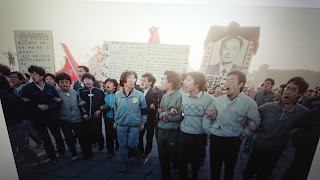
Students from the University of Politics and Law. The tall one by the red flag in back row is Pu Zhiqiang. The one wearing a black sleeve band in front is Wu Renhua.

Students sit down in front of the Great Hall of People waiting for the funeral, under the watchful eyes of police.

Students from Tsinghua University wait for the funeral.

Students waiting for the funeral

Students from University of Politics and Law sing patriotic songs.

Students in the Square observe a moment of silence at the start of the funeral.

At the funeral inside of the Great Hall of People, leaders pay last respect to Hu Yaobang's body.

Students Zhang Zhiyong, Guo Haifeng, and Zhou Yongjun (from left to right) kneel down with their petition.

Other students persuade the kneeling three to give up the petition. 


Pictures of 1989


Sunday, July 15, 2012

Book About Tiananmen: The Martial Law Troops in June 4 Event


The book The Martial Law Troops in the June 4 Event (available only in Chinese) is the second book written and self-published by Wu Renhua, a participant of the 1989 student movement and eyewitness of the massacre, following his previous Inside Story of the Bloody Clearance at Tiananmen Square. This book was published in 2009 and is mostly available in Chinese book stores at Hong Kong and elsewhere, as well as the author's site online.

For the past 20 years or so, the author has spent enormous time and effort collecting and analyzing historical records of the movement, especially the details of the bloody massacre. This book is the fruition of his belief that "we must name the killers" as it collects some of the names of officers and soldiers in the Chinese People's Liberation Army who participated in the massacre.

For this purpose, this book adopted a style close to an encyclopedia. After an introductory chapter, every chapter focuses on one particular army or other military unit, laying out its history, its actions during the martial law and massacre, and a list of available names of that unit, all in the same structure. In the preface, the author claims that the book "provides a most complete list of military officers who had been promoted after the massacre and, for the first time, a list of names of the participant officers and soldiers." Compared to the "between 180,000 and 250,000" troops mobilized, estimated by the author, the list of more than 2,000 collected names is indeed minuscule. But it also reflects the extreme difficulty in such research.

Besides those two lists, a particularly interesting analysis is of the 15 dead soldiers who had been awarded with the "Guard of the Republic" by the government. The author points out that 6 of them actually died in an auto accident, another of disease, and yet one of friendly fire.

Troop actions in 1989 has of course received some attention in the historical literature. Timothy Brook's Quelling the People is but one example. But it is still rare to see such systematic and detailed description of all military units as in this book.

The book also has its shortcomings. It only contains very few references for its sources, most of which referring to a few propaganda books published by the government in the immediate aftermath. Much of their contents were used directly without critical analysis. Some material in the book, including the names, are not sourced.

Due to its reference book style structure, this book is not very readable to the average reader. It is also difficult to use as it failed to provide an index. Therefore, its readership may be restricted to scholars and those who have keen interests in all things military. Nonetheless, this book will stay as a unique reference to one facade of the 1989 movement.


Books about Tiananmen


Sunday, April 24, 2011

Book Review: Inside Story of the Bloody Clearance at Tiananmen Square

The Inside Story of the Bloody Clearance at Tiananmen Square is a book currently only available in Chinese language. The book was published about 4 years ago at the 18th anniversary of the Tiananmen massacre.

This book was written by Wu Renhua, an integrate character in the 1989 student movement and in my own book Standoff at Tiananmen. As early as April 17, 1989, Wu Renhua, then a teacher at the University of Political Science and Law, had helped to organize the very first public demonstration following Hu Yaobang's death. Later on June 3rd, just as the bloody crackdown was approaching, he volunteered to lead a special team of student marshals into the Square to safeguard the hunger striking "Four Gentlemen" there. It is also because of this act, he put himself right in the middle of the actions of that fateful night. From the vantage of his location on the top of the Monument of People's Heroes, he had an excellent view of the entire Square.

After the massacre, Wu Renhua eventually escaped by swimming to Macao through icy sea water. He settled at Los Angeles and was the chief editor of a dissident newspaper Press Freedom Herald for many years. Through the paper he collected and published numerous articles on the history of the movement.

The book Inside Story of the Bloody Clearance at Tiananmen Square was the first book Wu Renhua wrote. It traces, hour by hour and sometimes minute by minute, the some 20 hours from when he arrived at the Square in the early afternoon of June 3, 1989 to the dawn of June 4, as he led the last group of the students withdrawing from it under gunpoint.

It was not just a timeline, however. The author also included much material that were written by others which added either scenes from locations the author could not witness directly or to the historical perspectives to the individuals and events.

There are indeed surprised. The most startling of which is the exact sequences of students' exit from the Monument, their last base in the Square. Previously, it was widely believed that they made a remarkably orderly retreat after a voice vote conducted by Feng Congde, therefore avoided a potentially horrendous bloodshed. Yet Wu Renhua pointed out from his own experience that only less than half students followed that decision and left in somewhat orderly fashion. The majority of them insisted to stay and left only after a combination of persuasion from their teachers and brutal beatings by the advancing soldiers. Their final withdraw was chaotic and almost fatal. At least one student leader was almost stampeded to death.

This, and much of the author's own observations that night at the Square, was adopted in the final Chapter of Standoff at Tiananmen.


Wu Renhua's book is not without shortcomings. As a self-edited and self-published book, it lacks sophisticated layout control. This is especially a problem when the author quotes substantial passages of other people's work. It is easy for readers to get lost and confused with what they are actually reading. Some of these materials used in the book had not been properly vetted for credibility and reliability and contain paragraphs that are known to be untrue or vastly exaggerated.


Tuesday, May 19, 2009

Book Excerpt: Ending the Hunger Strike

The following excerpt is from my book Standoff at Tiananmen, chapter 10, describing how the hunger strike finally came to an end.

The Hunger Strike Headquarters had expanded to include Feng Congde and Zhang Boli as deputies. It had also become obvious that the commander-in-chief rarely made any decisions of significance herself. Chai Ling delegated it entirely to her trusted deputy Li Lu. Whenever needed, however, she made passionate and inspiring speeches that kept everybody together. In this morning, an audio tape of Zhao Ziyang's speech during his bizarre visit was broadcast over the loudspeakers on top of their bus. A feeling of desperation slowly sank in. The dark shadow of death or permanent body damage was on the horizon.

Rumors were rampant. At Xinhuamen in the afternoon, Wu Renhua was pulled aside by a middle-aged bureaucrat who called his name. Wu Renhua and his fellow teachers and students from the University of Political Science and Law had camped out there for days since they broke off from the main hunger strike camp, effectively shutting down this main entry to Zhongnanhai. The man revealed his identity in confidence and told Wu Renhua that Zhao Ziyang had already been deposed and martial law was imminent in Beijing. Wu Renhua immediately dispatched a trusted student marshal to the Square with this information.

Meanwhile, Zhang Boli was talking with Li Lu when two intellectuals came in for him with urgent news. They literally dragged him across Chang'an Avenue to the Working People's Cultural Palace, a park bordering Tiananmen on the east. There, they told him that martial law would be declared by midnight and it was imperative for the students to call off the hunger strike. There was still hope, they urged, that if the hunger strike was called off, the martial law troops would lose their justification to enter the city.

Zhang Boli had no quarrel with calling off the hunger strike. But it was not his decision to make. So he rushed back and talked to Li Lu first and then found Chai Ling. To Zhang Boli's greatest surprise, both of them agreed instantly to stop the hunger strike. A general meeting of the student parliament was immediately called and commenced in an empty bus. Student marshals were ordered to establish a tight picket line around it. They were ordered not to allow anyone to interrupt this meeting, especially Wuer Kaixi if he showed up.

Inside the bus, the meeting was uncharacteristically brief and smooth. The rumor of looming martial law was not revealed. Chai Ling and Li Lu proposed a decision to stop the hunger strike entirely on humanitarian grounds. With their endorsement and the life-threatening danger, there was not much resistance among the previously aggressive representatives. With 173 of them voting for stopping the hunger strike, 28 against, and 7 abstaining, the decision was made.

Just then, Wuer Kaixi angrily burst onto the bus, followed by doctors and nurses holding intravenous bottles that were attached to him. He had been fighting the student marshals who at the end were no match for his fame and determination. Wuer Kaixi was not at all pleased at being excluded even though he was neither a member of the Headquarters nor a representative from his school. Wuer Kaixi had his way though. As the supreme leader in his Beijing Normal University, he dismissed the representative from his school on the spot and assumed the role himself, notwithstanding the fact that the meeting had already adjourned with a decision made. The new representative Wuer Kaixi insisted on reopening the session with a claim that he had critical information to present. It was then that Wuer Kaixi finally bothered to inquire what the decision was. Upon being told of the end of hunger strike, he raised his hand and meekly said "I agree."

Wuer Kaixi had felt the urge to see Yan Mingfu one more time that afternoon. He sneaked into the United Front Department in an ambulance with his girlfriend Liu Yan. After much cajoling, Yan Mingfu came out to meet him and give him the news of the impending martial law. Sensing the gravity of this development, Wuer Kaixi dispatched Liu Yan to get as many hunger strike leaders at the United Front Department as possible. They would have to talk it over with Yan Mingfu.

Ma Shaofang and Cheng Zhen showed up first. They were immediately overwhelmed by the news. They cried and swore to give up water or set themselves on fire in protest. Yan Mingfu, being the father-figure he was, managed to calm them down. Eventually, Wang Dan, Xiang Xiaoji, Shen Tong, and a few others arrived. Only the leaders in the Hunger Strike Headquarters were missing. Nevertheless, they had a quick meeting and reached a decision to call off the hunger strike.

Yan Mingfu was greatly relieved. He had his office cafeteria prepare a big pot of noodles for the students. Everyone ate despite the fact that their decision to resume eating was neither official nor made public. It was the best meal of their young lives. A gigantic load had just been lifted off their small shoulders. For that moment, the coming martial law did not feel like a big deal. They talked, laughed, snapped pictures, and playfully signed autographs for each other. Wuer Kaixi clumsily knocked down two thermos bottles, causing explosions that amused everyone. Then, they boarded separate vans to head back to Tiananmen Square, where Wuer Kaixi had to fight through student marshals to bring their decision to the parliament meeting.

Now that Chai Ling, Li Lu, Wuer Kaixi, and the student parliament were all in agreement, it was just a matter of announcing the decision to the thousands of hunger strikers. Zheng Yi already had a statement drafted. In the headquarters bus, Chai Ling read it calmly. It was broadcast through their loudspeakers.

The reaction was immediate and chaotic. Loud and angry shouts of "Traitor!" erupted all around. Many converged on the big bus. They pounded and shook it. As Li Lu was trying to calm down the crowd with his microphone, Feng Congde shot into the bus. He had just returned from a hospital and heard about the parliament meeting. He argued that the meeting was not properly called and that there were not enough representatives present to make such a critical decision. So, he called for a meeting of his own. In his hasty but carefully audited meeting, eighty percent of delegates voted against the ending of the hunger strike. Chai Ling, Li Lu, and Zhang Boli were outraged at his unilateral action. They refused to recognize the meeting and its result. A shouting and pushing match ensued in the headquarters bus and a deeply hurt Feng Congde resigned in protest.

Grudgingly, the breaking of the fast became a matter of fact. Li Lu carefully arranged student marshals to take the weakest hunger strikers to hospitals or back to their campuses. Others chose to stay. While slowly taking in food, they decided to continue their occupation of the Square as a massive sit-in. Zhang Boli was ushered, or rather, carried by a two people to the entrance of the Museum of Chinese History. There was a telephone waiting for him. He picked up the phone and identified himself. A voice on the other end informed him that they were the State Council and they were ready to record what he had to say. Zhang Boli read the statement into the phone. He then distributed copies to several reporters from CCTV and People's Daily.

CCTV was unusually efficient this time. At nine o'clock, as the regular news broadcast was in progress, a line of scrolling text appeared at the bottom of the screen: "Students at Tiananmen Square Stop their Hunger Strike."

Saturday, April 18, 2009

Place of 1989: Xinhuamen (新华门)


Xinhuamen (新华门), or the Gate of New China, is the main entrance of Zhongnanhai, the secretive compound that houses the leadership of both Communist Party and the central government of China.


Just west of Tiananmen Square, Xinhuamen is not a place that attracts a lot of attention. The gate itself was converted from a building when the compound needed an easy access to the Chang'an Avenue outside of its red wall on the south.

The gate is decorated by two giant sloans on each side. The one on the left says "Long Live the Great Chinese Communist Party!" and the other says "Long Live the Victorious Mao Zedong Thought!" The front door of the gate is always open with a pair of soldiers standing guard all the time. Padestrans are always advice to keep their distance.

During the 1989 student movement, Xinhuamen became the focal point in the first nights of protest. As early as April 17, thousands of students gathered in front of the gate to demand an audience with Premier Li Peng. The crowd was finally dispersed in the wee hours of the morning.

But they returned the next evening with even more forces and determination. They actively engaged in a push-and-shove game with the guards for hours. Student leader Wuer Kaixi made his first public appearance that night on the scene and impressed many people with his courage and determination. Police finally broke through the crowd and forced the protesting students into buses. Many people suffered minor injuries during the scuffle. Exagerated accounts of the events were then public displayed as the "April 20 Tragedy" among the many college campuses in Beijing.

A month later, Xinhuamen also became a site of hunger strike when a group of teachers and students from University of Political Science and Law broke from their main camp in Tiananmen Square and staged their own hunger strike here. They effectively shut down this entrance for weeks.
During the day of June 3, a van carrying military weapons was discovered on Chang'an Avenue just outside of Xinhuamen. Students ceased the vehicle and displayed the guns on its tops. Around noon, police charged the crowd with tear gas and recovered the weapons. It was the first time tear gas was used.

Friday, April 17, 2009

This Day in 1989: April 17, Students March to Tiananmen Square

After spending the entire previous day making a huge wreath, Chen Xiaoping and Wu Renhua were pleasantly surprised that their note had garnered a few hundreds of students at their University of Political Science and Law. At 1pm, April 17, 1989, they headed out of the campus toward Tiananmen Square. It was the first demonstration of 1989, also a first since the Beijing government outlawed such activities two years earlier.

They arrived in late afternoon and placed the wreath on the base of the Monument to People's Heroes. Wu Renhua placed a small bottle of Maotai as a traditional dedication to the deceased. (It was later interpreted as a protest against Deng Xiaoping as "small bottle" is a homophone of "Xiaoping" in Chinese.)


At Peking University, Wang Dan and about 40 students delivered a wrath to Hu Yaobang's residence in the afternoon. But that evening, thousands of students were milling around The Triangle when the news of the demonstration came and shocked the crowd. They could not believe the tiny University of Political Science and Law could have gone ahead of Peking University, the traditional school in leading student movements.

In the darkness, they grabbed a giant banner, dedicated to Hu Yaobang as "China's Soul," and organized a march of their own. Wang Dan and his friends from the Democracy Salon were among the leaders.

They arrived at Tiananmen Square around midnight. The place was empty and quiet. The Monument to People's Heroes was now decorated with quite a bit of flowers and wreaths, including the giant one from University of Political Science and Law. Guo Haifeng climbed up the base of the Monument and placed the "China's Soul" banner in the middle.

Fearing that the dedications could be removed by the authorities during the night as it had happened during the April Fifth Movement in 1976, the Peking University students decided to stay the night in the Square to guard the wreaths.


Days of 1989


Thursday, April 16, 2009

This Day in 1989: April 16

The news of Hu Yaobang's death was slowly sinking in on April 16, 1989. Spontaneous memorial banners, flowers, and Big Posters were appearing in college campuses all over the country. Dozens of small flowers and wreaths also showed up at the Monument to People's Heroes at Tiananmen Square. There were not yet organized activities.

There were many rumors. Most centered on the theme that Hu Yaobang suffered a heart attack because the continued criticisms he was receiving during recent politburo meetings. Although baseless and most likely to be false, the rumors were wide spread and casting Hu Yaobang as the victim of other leaders such as Li Peng and Deng Xiaoping.

Among the banners, the most eye-catching was one that proclaimed, "The one who should have died did not; the one who should not have died did!" The quotation was attributed to Bing Xin, a famous author who was almost ninety years old. She was referring to her own advanced age while mourning for the death of the younger Hu Yaobang.

Yet the message immediately took on a new meaning in the public. "The one who should have died" was taken to refer to Deng Xiaoping, the old man who had wronged Hu Yaobang more than two years ago.

Meanwhile, a group of young teachers at the University of Political Science and Law were spending the day preparing for a giant wreath. This was the idea of Wu Renhua, who had graduated from Peking University. After almost an entire day of work, the wreath came to be almost seven feet in diameter and covered with paper flowers and banners. They placed the wreath at the center of the campus with an unsigned note announcing that the wreath would be delivered to Tiananmen Square at one o'clock next afternoon.

Wu Renhua did not know how many, if any, students from that conservative campus would join him.


Days of 1989


Thursday, April 17, 2008

So It Starts, With A Smashed Little Bottle

The spontaneous memorial activities immediately followed Hu Yaobang's death made its first appearance in New York Times on April 17, 1989:
In a nation where there are no opinion polls to assess the popularity of national leaders, what people do with small bottles may be the best indication of the remarkable rise and fall in the popularity of Deng Xiaoping.
''Xiaoping'' in spoken Chinese can mean ''small bottle'' - although the written character for ''ping'' in Mr. Deng's name is not the one used for ''bottle'' - and people seized on the symbolism a decade ago, when Mr. Deng was struggling to power and embodied the nation's hope for non-revolutionary prosperity. At that time, ordinary people registered their support for Mr. Deng by leaving small bottles in conspicuous places. These days, some people are expressing their feelings by smashing small bottles.
A decade ago, it was more talk than action, and these days, too, more people speak of breaking bottles than actually smash them. ''What's the point?'' explained a young man in Beijing. ''If you smash it in public, you might get arrested, and if you smash it at home, you just have to sweep it up.''
In any case, even Communist Party officials acknowledge that the public is growing tired of Mr. Deng. Some of the pent-up hostility has come into the open after the death Saturday of the former party leader Hu Yaobang, who was ousted two years ago after being criticized by Mr. Deng for tolerating intellectual dissidents and student unrest. Deng's 'Stature Isn't Going Up'
In the early hours this morning at Tiananmen Square, the center of Beijing and the political focal point of China, white paper flowers fluttered in the breeze where mourners had left them to honor Mr. Hu. The only sign of litter was a freshly broken small bottle.
The last sentence is particularly interesting as it refers to "a freshly broken small bottle", in the singular form. Was there only one smashed bottle in the Tiananmen Square that morning?

The first big wreath to reach Tiananmen Square came from the University of Political Science and Law. Normally an ultra-conservative school, UPSL was never known for political activism. That was Beida's job. But in 1989, a group of graduates from Beida has settled in UPSL and formed a core of young teachers in that school, including Chen Xiaoping and Wu Renhua.

Chen Xiaoping learned about Hu Yaobang's death on the same day, before it was broadcast. He brought the sad news to UPSL and gathered his fellow young teachers in his dorm room. Wu Renhua proposed to build a wreath and place it under the Monument of People's Heroes at Tiananmen Square. They spent a day building the wreath, a big one indeed, and placed in front of the main building on campus to raw attention. An announcement accompanied the wreath, declaring the intention of sending the wreath to the Square next day. There was no organizer on the announcement, just a note saying anyone interested could join.

At 1pm on April 17 (Beijing Time), Chen, Wu, and others led their contingent of several hundreds out of the campus, with the wreath on a flatbed tricycle. Wu Renhua had a bottle of Maotai, the most famous spirit in China. He tied the bottle to the wreath, as a dedication to the dead in the traditional Chinese fashion. He didn't think much of it. But it would eventually come back to bite him in the aftermath of the Massacre, as the bottle was re-interpreted as an insult to Deng Xiaoping.

On that day, however, the possession marched through main streets of Beijing without incident, under the watchful eyes of police. They reached Tiananmen Square by 5pm. By now they had drawn a crowd of more than 5,000. Fearing for the situation getting out of control, they rushed through a simple dedication ceremony, sang The Internationale, and placed the wreath on the basis of the Monument.

The bottle on the wreath disappeared soon after they left. Someone might have smashed it in the Square. But there is no way to know if that is the one reported by NYT's Nicholas Kristof.

Beida's students, having been late out of the gate, also reached Tiananmen Square in the pre-dawn hour that night. They placed a gigantic banner, inscribed with three huge Chinese characters: China's Soul (中国魂), on the monument. More would be coming in the following days.

The Beida contingent was led by Wang Dan. And they did not immediately leave the Square the next day.

Thursday, March 6, 2008

Exiled Tiananmen Leaders Appeal for Rights to Citizenship

Nineteen years after the Tiananmen Massacre, most of the then student leaders and intellectuals have come abroad. Some of them had escaped China clandestinely. But most left China legally, either as private visitors after having served their sentences in China or were "sent out" by the Chinese government in one of her "humanitarian" gestures to the world.

But no matter how they got here, they all share the same fate: their citizenships are forever in a limbo state. Even if they came with valid Chinese passports, the Chinese embassies and consulates here refused to renew them. So their passports had expired years ago. They could still travel as UN refugees, but they are, quite literally, people without a country.

Today, some of these leaders, including Wang Dan, Hu Ping, Chen Yizi, Wuer Kaixi, Liu Gang, Chen Xiaoping, Wu Renhua, and Wang Juntao, published an open letter to the Chinese Ministry of Foreign Affairs to demand their rights of citizenship. They also appeal to UN and the International Olympic Committee to help.

The letter also indicated that these leaders are ready to try various legal actions against the Chinese government if their demands are not answered within a month. It also hinted that they might try their own ways to return to China.