On February 12, 1991, Beijing Intermediate People's Court announced that Wang Juntao and Chen Zimin had each been sentenced to 13 years of prison for their "attempting to overthrow the people's government and socialist system" during the 1989 movement.
Also announced was that Liu Gang received a 6 year sentence while Chen Xiaoping was released without prison terms.
Days of 1989
Showing posts with label Liu Gang (刘刚). Show all posts
Showing posts with label Liu Gang (刘刚). Show all posts
Monday, August 7, 2017

People of 1989: Yu Haocheng (于浩成)

A well-known legal scholar, Yu Haocheng was a Manchu, one of the many ethnic minorities in China. His father was a student leader during the May Fourth Movement in 1919, who later became a department head in Yenching University, the precursor of Peking University, and participated in the Communist underground. Influenced by his father and elder brother, Yu Haocheng participated in the revolutionary activities led by the Communist Party from a very early age. However, his fortune was not blessed: In 1947, he was labeled as an "anti-Party element" and almost expelled from the Party. Then in 1968, he spent three years in the Qincheng prison as a "counter-revolutionary."
After being rehabilitated in the late 1970s, Yu Haocheng became the head of a small publishing house, as well as the editor-in-chief for the scholastic journal Legal Studies. He became an active figure in the intellectual circle in Beijing. In 1988, he was a part of the effort to launch a magazine New Enlightenment, for which he wrote an essay titled "People should Have the Freedom from Fear."
In February, 1989, Yu Haocheng cosigned an open letter with other intellectuals in Beijing, calling for political system reform. Thereafter and through out the student movement, he maintained a consistent presence in the various demonstrations and meetings among the intellectuals, including as a part of the 12 scholars who went to Tiananmen Square in an attempt to persuade students stop their hunger strike.
After the crackdown, Yu Haocheng was officially expelled from the Communist Party and was jailed for a year and a half. One of his chief offensives was that he had once made suggestions to Liu Gang when the latter was drafting the charter for the new Beijing Students Autonomous Federation.
In his elder years, Yu Haocheng toured several universities in the US and wrote memoirs. In 2008, he was an early signatorie for the "Charter of 2008."
Yu Haocheng passed away in Beijing on November 14, 2015. He was 91.
People of 1989
This Day in 1989: June 19, 1989, Han Dongfang Turns Himself In, Liu Gang Arrested
In the morning of June 19, 1989, Han Dongfang, a workers' leader during the movement, turned himself in to the police in Beijing.
In that evening, Liu Gang was arrested in a park at Baoding City. He had been on the run under disguise but his cover was blown by local police on patrol.
Also on that day, the Party Politburo held an extended meeting to discuss policies in the aftermath of massacre.
Days of 1989
In that evening, Liu Gang was arrested in a park at Baoding City. He had been on the run under disguise but his cover was blown by local police on patrol.
Also on that day, the Party Politburo held an extended meeting to discuss policies in the aftermath of massacre.
Days of 1989
Sunday, May 31, 2015
People of 1989: Pu Zhiqiang (浦志强)
Born in 1965, Pu Zhiqiang graduated from Nankai University as a history major in 1986. By the year of 1989, he was a graduate student of law at the University of Political Sciences and Law.
The school, although small in size, was a major force throughout the 1989 student movement. As early as April 17, teachers and students from that school had launched the first march of the year. Pu Zhiqiang joined Chen Xiaoping and Wu Renhua in that march to lay a giant wreath at Tiananmen Square in memory of Hu Yaobang. On April 22, students marched into Tiananmen Square again to participate the funeral. Pu Zhiqiang was there. He was so overcome by emotion that he smashed his own head with a bullhorn, which caught the attention of Liu Gang. Liu Gang tried to talk Pu Zhiqiang into running for the leadership of Chinese Students Autonomous Federation, but Pu Zhiqiang declined out of modesty.
During the great demonstration of April 27, the lanky Pu Zhiqiang was at the front row of his university with the flag of his school. From then on, he could always been seen at the forefront of each demonstration.
On the night of the massacre, Pu Zhiqiang was in Tiananmen Square throughout the ordeal and was among the last people withdrawn from there. He made a vow then and there that he would return on that day every year to commemorate the victims. For the more than twenty years since, he kept his promise, except for a couple of years when he was detained by police preventing him to do so.
Although an active participant of the movement, Pu Zhiqiang escaped serious punishment thanks to the actions of his school officials. He graduated with a masters degree in 1991 and obtained license to practice law in 1995. He gradually becomes a prominent civil rights lawyer, defending many dissidents against the government prosecution, including the famous case of Ai weiwei. He is also very active and daring in social media, often criticizing government's policy. His accounts were often blocked or deleted.
In February, 2013, the magazine Southern People Weekly published an issue with him being the cover figure. In the issue, he was quoted as saying, "I kept my principle. They didn't. The people in power today, they are more or less at my age. They had experienced the latter stage of the Cultural Revolution, the liberalization in the 1980s. But at some point of their lives, they gave up and perhaps could never keep their principles. Because they no longer have their grounds."

In May, 2014, Pu Zhiqiang participated in a private gathering commemorating the Tiananmen Massacre in Beijing. He was soon detained afterwards. A year later, on May 15, 2015, he was formally charged with "causing nationality hatred and disturbing peace."
On December 21, 2015, Pu Ziqiang was sentenced to 3 years of prison but spared of actually serving them, after he wrote a statement promising good behavior.
People of 1989
The school, although small in size, was a major force throughout the 1989 student movement. As early as April 17, teachers and students from that school had launched the first march of the year. Pu Zhiqiang joined Chen Xiaoping and Wu Renhua in that march to lay a giant wreath at Tiananmen Square in memory of Hu Yaobang. On April 22, students marched into Tiananmen Square again to participate the funeral. Pu Zhiqiang was there. He was so overcome by emotion that he smashed his own head with a bullhorn, which caught the attention of Liu Gang. Liu Gang tried to talk Pu Zhiqiang into running for the leadership of Chinese Students Autonomous Federation, but Pu Zhiqiang declined out of modesty.
During the great demonstration of April 27, the lanky Pu Zhiqiang was at the front row of his university with the flag of his school. From then on, he could always been seen at the forefront of each demonstration.
 |
| Pu Zhiqiang in a bicycle rally calling for press freedom on May 10, 1989. |
 |
| Pu Zhiqiang (center) leads the University of Political Sciences and Law contingent to hunger strike on May 13, 1989. |
 |
| Pu Zhiqiang in hunger strike, May 1989. |
Although an active participant of the movement, Pu Zhiqiang escaped serious punishment thanks to the actions of his school officials. He graduated with a masters degree in 1991 and obtained license to practice law in 1995. He gradually becomes a prominent civil rights lawyer, defending many dissidents against the government prosecution, including the famous case of Ai weiwei. He is also very active and daring in social media, often criticizing government's policy. His accounts were often blocked or deleted.
In February, 2013, the magazine Southern People Weekly published an issue with him being the cover figure. In the issue, he was quoted as saying, "I kept my principle. They didn't. The people in power today, they are more or less at my age. They had experienced the latter stage of the Cultural Revolution, the liberalization in the 1980s. But at some point of their lives, they gave up and perhaps could never keep their principles. Because they no longer have their grounds."
In May, 2014, Pu Zhiqiang participated in a private gathering commemorating the Tiananmen Massacre in Beijing. He was soon detained afterwards. A year later, on May 15, 2015, he was formally charged with "causing nationality hatred and disturbing peace."
On December 21, 2015, Pu Ziqiang was sentenced to 3 years of prison but spared of actually serving them, after he wrote a statement promising good behavior.
 |
| Hand-written statement by Pu Zhiqiang when he was in prison on December 20, 2015. |
People of 1989
Tuesday, April 14, 2015
This Day in 1989: April 12, Wu Zuguang Speaks at Democracy Salon
On April 12, 1989, students in Peking University had their weekly Democracy Salon again, this time with the featured speaker Wu Zuguang, a prominent liberal intellectual. A couple of hundreds students showed up.
Wu Zuguang had already attended Democracy Salon sessions in 1988, hosted by Liu Gang.
This Day in 1989
Wu Zuguang had already attended Democracy Salon sessions in 1988, hosted by Liu Gang.
This Day in 1989
Saturday, March 21, 2015
This Day in 1989: The Democracy Salon is Revived in Peking University
On March 22, 1989, about a hundred students at Peking University attended a session of the Democracy Salon on campus. Wang Dan led the session and a graduate student gave a speech on the "New Authoritarianism," a trendy topic of the day.
The Democracy Salon was originally founded by Liu Gang almost a year earlier. In 1988, it hosted several prominent intellectuals, including American Ambassador Winston Lord, to provide interactive discussions with students. The Salon did not survive for long when the school banished it after an unrelated incident resulting to the death of a student. After that, Wang Dan had been hosting small, secretive sessions in his dorm building.
This is the first time the Salon is once again held outdoors in the open.
This Day in 1989
The Democracy Salon was originally founded by Liu Gang almost a year earlier. In 1988, it hosted several prominent intellectuals, including American Ambassador Winston Lord, to provide interactive discussions with students. The Salon did not survive for long when the school banished it after an unrelated incident resulting to the death of a student. After that, Wang Dan had been hosting small, secretive sessions in his dorm building.
This is the first time the Salon is once again held outdoors in the open.
This Day in 1989
Saturday, April 7, 2012
People of 1989: Fang Lizhi (方励之)

Professor Fang Lizhi was born on February 12, 1936. In the mid-1940s when he was only 12 years old, he witnessed some student movements in his middle school and joined an underground Communist organization. In 1952, he enrolled in the Physics Department at Peking University and formally became a member of the Communist Party upon graduation. But soon he got in trouble in the "Anti-Rightists" movement and was expelled from the Party and sent to countryside to be "re-educated" through manual labor. He was only 23 then.
It was during that dark period that Fang Lizhi married Li Shuxian, a formal classmate at Peking University who had also been expelled from the Party. The couple survived living and laboring in separate countryside locations and gave birth to two sons during that time.
After the Culture Revolution, Fang Lizhi was able to return to academia and by mid-1980s he had become a professor and Vice President of the University of Science and Technology of China in Anhui Province. It was there he launched a fruitful career as a pioneer researching relativistic cosmology in China. But he gained great fame by giving inspiring speeches in many universities advocating liberty, democracy, and human rights, using western examples he had observed from his frequent travels abroad. Audiotapes of his speech were widely copied and passed around in student dorm rooms. At that time, he called for young students to join the Communist Party and "reform it from within."
In December, 1986, when students at USTC were planning a demonstration protesting election rules, Professor Fang Lizhi gave a rousing speech to a student gathering during which he famously declared that "democracy could not be given from above but had to be demanded from below." But nonetheless, he tried to persuade students to limit their actions within the campus. He failed on that as students marched downtown.
A few weeks later, after a wave of student demonstrations that swept the country including cities such as Shanghai and Beijing, Fang Lizhi was once again expelled from the Party and stripped of all his positions in USTC. He was relocated to Beijing and assigned a research position at the Beijing Observatory. In 1988, Liu Gang engineered a campaign at Peking University to successfully elect Li Shuxian as a local People's Representative, partly to salute Professor Fang Lizhi.
On May 4 that year, Fang Lizhi and Li Shuxian participated as speakers the first "Democracy Salon" organized by Liu Gang at Peking University.

In January, 1989, Fang Lizhi suddenly broke his silence again by issuing an open letter to Deng Xiaoping calling for an amnesty of political prisoners including Wei Jingsheng. The letter was echoed by a few similar ones co-signed by prominent intellectuals and the like. In February, he wrote an essay titled "China's Despair and China's Hope" declaring that "the 40 year Socialist experiment in China has failed." The essay was published in New York Review of Books and Hong Kong presses but also posted as a Big Poster at Peking University. By that time, he had abandoned the idea of reforming the Party from within and advocated that "We must also take action from outside of the system. We must force the issue in any way we can."
His words drew attention everywhere. That February, Fang Lizhi and Li Shuxian were invited to attend a state bangquet hosted by the visiting President George H. W. Bush but were brutally stopped near the party by a swarm of police.
As the 1989 student movement was ignited after Hu Yaobang's death, Fang Lizhi chose to stay behind the scenes so that he would not bring unwanted attention or trouble to the movement. Earlier on, he did provide private advices to a few student leaders such as Liu Gang and Wang Dan but refused invitations to make public speeches. Later, he expressed his displeasure of the aggressive tactics in the movement:
Once the hunger strike started, the movement went out of control, and I suspected that the government would use military means to end it. These students just did not understand. They grew up in the generation after the Cultural Revolution and had never seen the Party kill people on a large scale. The students loved that line in L'Intenernationale about this being the final struggle, but I told those who came to my home that this was most definitely not the final struggle. They felt that if they just carried this struggle through, they would be victorious. I didn't think so.
Nevertheless, Fang Lizhi and Li Shuxian were publicly labeled as the "black hands" of the movement by the government. On May 31, several small-scale rallies organized by the government sprang up in the Beijing suburbs, in which "angry peasants" burned effigies of Fang Lizhi's likeness.
By then, Fang Lizhi already found himself followed when he left Beijing for an academic conference. Within hours after the massacre on June 3, he contacted the American Embassy through their American friend Perry Link and eventually gained protection there. Soon, government "Wanted" posters with the couple's pictures were all over the place:

They stayed in the Embassy for about a year while the China and US were engaged in a diplomatic standoff. Fang Lizhi managed to continue his scientific research there and published a paper bearing the diplomatic address. They eventually were allowed to leave China and reached US by way of UK.
Once on the US soil, Fang Lizhi immediately and openly criticized the American government's double standard on China's human rights and quickly lost confidence of the US government and faded from public view. He became a professor at University of Arizona and continued his physics research there.
Other than a few interviews, Fang Lizhi had largely avoided speaking about the 1989 student movement in detail. He was engaged in a few oversea democracy activities but stayed away from controversies and in-fights. In more recent years, he had been writing many witty and moving essays about his life and science, but seldom touched the subject of 1989.
Professor Fang Lizhi passed away in his home at Tucson, Arizona, on April 6, 2012. He was 76 and survived by his wife Li Shuxian and his eldest son. (Their second son, Fang Zhe, who had briefly accompanied them in the US Embassy, died in a traffic accident in 2007.)

Saturday, July 16, 2011
Liu Gang Launches Protest Against US Government and Companies
 1989 Chinese student leader Liu Gang was spotted outside of the White House with a home-made protesting poster yesterday. He was calling on the US government to act on what he termed as the "unrestricted warfare" conducted by the Chinese government on American soil.
Liu Gang has been embroiled in a nasty divorce after his second marriage fell apart. He publicly accused his estranged wife as a former Chinese military officer and that the Chinese government has launched a para-military campaign against him, his now-former employer, and other Chinese dissidents and American dignitaries. Almost a year ago, he sued Chinese president Hu Jintao in a New York court with similar accusations.
Liu Gang also claims that he was the initiator of the so-called "Jasmine Revolution" in China and that it made him a target of the Chinese government.
His public accusations of his wife and his former employer have led to him losing his job and being temporarily arrested a few times. But he has vowed to defy a court-ordered gag order and continue to protest his case in public. This morning, he declared he will travel around the country with his personal protests. He did not disclose details of his plan.
Sunday, February 27, 2011
Arab's Tiananmen and China's Jasmine
Ever since 1989, "Tiananmen" has become a catch-word depicting governments' suppressing and massacring their own people, or even the possibility of it, whenever and wherever a popular uprising occurs. The year of 2011 is no exception.
Almost as soon as people in Tunisia marched on the streets, the appearance of the word "Tiananmen" in world news skyrocketed. Fortunately, such dire predictions did not materialize there. In Egypt, tanks did roll on streets and in Tahrir Square. In most likelihood, a repeat of Tiananmen was averted only in the last minutes when soldiers disobeyed a direct order from Mubarak. Scores of protesters did perish there, but not as a result of direct military involvement.
It was a Libya the situation got much dicier. The reference to Tianamen gained a degree of formality when the dictator there, Muammar Gaddafi, made a direct link in one of his odd-ball speeches. In his immortal words, he invoked that history to justify his own stance:
People in front of tanks were crushed. The unity of China was more important than those people on Tiananmen Square.When Tiananmen Square happened, tanks were sent in to deal with them. It's not a joke. I will do whatever it takes to make sure part of the country isn't taken away.
As his people died in the hands of government troops in his "whatever it takes," the United Nation Security Council debated on how to deal with the atrocity. China, a permanent member of the council with veto power and the origin nation of the Tiananmen massacre, was put on a peculiar position. After some initial hesitation, China reluctantly joined the rest of the world to refer the Gadhafi regime to the International Criminal Court and impose sanctions to the country.
Perhaps the only location of uprising without a link to Tiananmen is at Madison, Wisconsin.
Meanwhile, the term "Jasmine Revolution," derived from the initial uprising in Tunisia, became a sensitive word in China. There has been chatters in China's twitter world that flashmob-style gatherings were called for in many cities there first on Sunday, 2/20, and then again on 2/27. Large-scale crowd failed to materialize on either occasion. But the buzz was loud enough to attract the attention of international media and, perhaps inadvertently, the US Ambassador.
Nobody has formally come out to take the credit or responsibility of the twitter activity yet, although it is increasingly clear that it had originated from the oversea Chinese dissident community instead of the younger generation in China as it was initially reported. Indeed, one of the 1989 student leaders, Liu Gang, had claimed being the originator in an Internet forum and accused others for hijacking and misleading the "revolution." Other exiled 1989 student leaders, including Wang Dan, Wuer Kaixi, and Wang Juntao, have also been active in propagating the messages in their social network circles. Wuer Kaixi joined a supporting protest by a dozen or so people in Taiwan and Wang Juntao sang the "Jasmine song," literally, at the Times Square in New York City.
So far, the ones who took this so-called "Jasmine Revolution" in China seriously are the Chinese authorities, who are busy blocking related web traffic and employing various tactics to prevent public gatherings in city centers. The police have far out-numbered the onlookers at the scenes.
But there are real and far more serious threats behind the scenes. More than a dozen human rights activists have been detained by police in recent days. Their involvement, or the lack thereof, to the phantom revolution is so far unclear. In the most serious cases, a leading blog writer, Ran Yunfei (冉云飞), and others are being charged with subversion or inciting subversion, convenient crimes for government to charge dissidents in recent years. They will be facing lengthy sentences.
Monday, September 13, 2010
Liu Gang Sues Hu Jintao in New York

According to the Internet news source boxun.com, 1989 student leader Liu Gang has filed a lawsuit in the United States District Court at Southern District of New York. The suit lists Chinese President Hu Jintao and three other top military leaders in China as defendants. It claims that the Chinese military has been dispatching its personnel to the US and conducting activities detrimental to the life, career, and safety of Chinese dissident such as Liu Gang himself.
In the last few months, Liu Gang also published articles in Internet forums detailing his troubled marriage and court battles involving divorce and accusations of domestic violence. He has hinted that Chinese government agents may be behind what he describes as his wife's irrational and erratic behaviors.
Wednesday, May 27, 2009
Book Excerpt: May 27, 1989
The following excerpt is from my book Standoff at Tiananmen, chapter 11, describing the events of May 27, 1989, which in retrospect became one of the pivotal moments of the student movement.
In the morning of May 27, Liu Gang came to Tiananmen Square with a single mission in mind. He had to get the leaders of Headquarters for Defending Tiananmen Square leaders into the conference to discuss a plan for the future. Li Lu had never attended the conference after its first day. He regarded it only as a farce. Occasionally, he sent Chai Ling over so that she could get away and catch some rest during those boring meetings. With his own student parliament backing the headquarters, Li Lu had neither time nor necessity to be involved in the Capital Joint Conference. Liu Gang had come to understand that, for any plan to have a chance, it had to be with the approval of Chai Ling and Li Lu.
But Liu Gang could not persuade Li Lu to attend the meeting this morning. Chai Ling and Feng Congde went with him instead. It happened to be the best attended session in days. There were about a hundred people in a large conference room. Feng Congde, who was a stranger to this scene, recognized many familiar faces. He was surprised to find Wang Dan, absent from Tiananmen Square, playing a central role. But he did not know Wang Juntao, who was there to chair this important proceeding. The agenda was to discuss the second task he had set when he opened the conference four days earlier: a clear and unified goal for the movement.
The meeting opened with Chai Ling briefing on the current situation. To the surprise of many, she gave a depressing account of deterioration. The newcomers from the provinces were out of control. They had started their own organizations to fight with her headquarters for power. Garbage was piling up and the place stank. Chai Ling was exhausted and did not appear at all like a commander-in-chief ready to defend Tiananmen Square. Yang Tao's proposal to vacate the schools was then brought up but received only lukewarm reaction. Wang Dan thought the idea impossible to implement. Wuer Kaixi concurred but added that he would be willing to travel to the provinces himself to drum up popular support for Beijing.
Wang Juntao brought the meeting back to its agenda. A couple of writers in the group had drafted another statement, plainly titled Our Ten-Point Statement regarding the Current Situation. It was a laundry list of their collective opinions and demands. To the great dismay and frustration of Feng Congde and Chai Ling, the intellectuals proceeded to argue hours over fine wording choices point by point. At one instance, a prolonged debate erupted regarding whether to use the phrase "purely spontaneous" or "essentially spontaneous" to describe the origin of the movement. Feng Congde noticed that many of the attendees were dozing off. Now he understood what Li Lu had been saying about this conference.
Wang Juntao ordered Kentucky Fried Chicken for lunch. It was a meal of luxury for most people in the room. Like almost everybody else, Chai Ling had a very favorable impression of Wang Juntao. She found him understanding and supportive. A rare person in this crowd whom she could trust. Wang Juntao had been conscientiously playing out the role of his version of George Washington. He went out of his way to make sure that everybody could have a voice in the conference and avoid making any judgment of his own. He smiled and nodded eagerly even when he was listening to something he thought ridiculous or disagreeable. While his approach was winning friends and keeping the conference together, his all-pleasing style was also frustrating his closer friends. "Unprincipled," many scoffed publicly. Liu Gang worried that frequent changes in Wang Juntao's stance could be costing them precious opportunities.
During the lunch break, they learned that Wan Li, the Chairman of the National People's Congress Standing Committee, had issued a written statement from Shanghai in support of martial law. It was yet another major setback.
The meeting continued in the afternoon on their Ten-Point Statement. The eighth point spelled out that, if an emergency meeting of the National People's Congress Standing Committee was not called, the occupation of Tiananmen Square would continue at least until June 20, the date for a regular meeting of the same committee. There was no objection to this deadline until Feng Congde rose to speak. As the person in charge of finance, he told the conference that it was not financially possible to sustain the occupation for another three weeks. In fact, he did not think it could last even a couple more days. He proceeded to explain how they were running a large deficit. He demanded that the departed Beijing Students Autonomous Federation return donated funds to the Square.
The audience was shocked. For all their grandiose visions of revolution and victory, they had paid little attention to such details as money and bread supply. Under pressure, a student in charge of finance for the Federation promised to release some of its funds right away. But he also claimed that their fund was not large either. With the burn rate Feng Congde cited, it would not come close to sustaining them till June 20.
Wang Juntao did not think the monetary shortfall was a serious threat. Sizable donations from Hong Kong and Taiwan were already on their way. But Feng Congde's numbers coupled with Chai Ling's briefing had already caused the pendulum to swing to the side of an earlier withdrawal. To the dismay of a few die-hards, the conference quickly settled on a withdrawal date of May 30, chosen to give the headquarters a couple of days to prepare. All eyes were turning to Chai Ling. It would be this diminutive but determined commander-in-chief who would have the final say.
Chai Ling was much more exhausted than determined at this very moment. She spoke up quietly and softly. It had been a grueling time for her since the start of the hunger strike. Despite all efforts, the situation at Tiananmen Square was dreadful. She was ready to have all this over. Yes, she told the conference, as she raised her hand, she agreed with the withdrawal plan. Almost everybody else followed. It was noted as an unanimous decision.
It was now late afternoon and they finally finished with their statement. But the meeting was not yet over. Liu Xiaobo, a young professor of literature at Beijing Normal University, suggested that they needed a more visible leader for the movement. One who was to be a public hero or a Chinese Lech Walesa, the famous leader of Polish Solidarity. Only with such a figure, he declared, could this movement unite the people and sustain its civil opposition after withdrawing from Tiananmen Square. He already had a candidate and he immediately nominated Wuer Kaixi for the role to be named as the "Spokesman of the People."
The thirty-four year old Liu Xiaobo had been traveling abroad teaching Chinese philosophy and literature in Norway and the United States. He was visiting Columbia University that spring when he felt an irrepressible urge to join the emerging movement. So he hopped on a plane home. As he was transferring at Tokyo, he learned about the publication of April 26 People's Daily editorial. In a moment of truth, he hesitated between continuing onto Beijing or flying back to New York. Beijing won out.
Back home, he was happy to find students from his school at the center of the storm. Now at the conference, he showered accolades on Wuer Kaixi as a natural leader. Likewise, Wuer Kaixi was ready. He followed up with a speech to claim himself the most charismatic and recognized leader of the movement. He appeared to be well received by the audience.
But Feng Congde was beyond himself. He angrily objected the nomination and accused Wuer Kaixi of being immature, lacking experience, and, worst of all, having a strong tendency to speak for himself in total disregard of rules and regulations. He was referring to the unilateral moves Wuer Kaixi had made at Tiananmen Square that had resulted in his own banishment. To his credit, Wuer Kaixi did not dispute the charges. He defended himself by saying that he could now do a better job with teachers like Liu Xiaobo as his advisers.
That was the last straw. Feng Congde and Chai Ling had no more patience left. They had already spent seven hours in this meeting and it was time to leave. As a parting shot, Chai Ling declared that her Headquarters for Defending Tiananmen Square was no longer on the same page with this conference. As they walked out in disgust, the motion to make Wuer Kaixi the Spokesman of the People was tabled. Wang Juntao rushed out to comfort the angry couple.
Leaving the conference, Feng Congde rushed to Peking University to follow up on funds promised by Beijing Students Autonomous Federation. Chai Ling went back to Tiananmen Square by herself. The images of Liu Xiaobo and Wuer Kaixi lingered in her mind. She had seen too many instances of people trying to wrestle leadership from her. From Beijing Students Autonomous Federation to new arrivals from the provinces, they had always tried to overthrow her headquarters and seize power. Now this Capital Joint Conference, which had backed her just a few days ago, was turning against her as well. As she got closer to Tiananmen Square, Chai Ling started having serious second thoughts about the decision to withdraw in three days.
Tiananmen Square was not her sanctuary on this day either. As she was walking in, the sad realities sank in all at once. It was a dirty and pathetic place. People were tired and angry. A young student marshal came to her in anger and disgust. He told her that he had come from Qingdao, a port city in northeast China. Hundreds of his schoolmates had come together to join the movement. Because of the school uniforms they were wearing, all of them were immediately assigned duties as marshals to work on picket lines protecting the Headquarters for Defending Tiananmen Square. They all worked hard for many days, he told Chai Ling while crying. But what had they witnessed so far? Nothing good, he said. We saw you leaders come and go without doing anything of substance. We saw so much infighting and corruption. We did not see anything good at all! He told Chai Ling that most of his schoolmates had already returned home with profound disappointment. There were only a dozen or so left. Why did he choose to stay? He said, I just did not want to give up. I just wanted to see how bad things could get at the Square and whether our country still had any hope left!
There it was, an echo directly from the Hunger Strike Manifesto Chai Ling had written in her own emotional days. It was almost exactly the same language she had used to inspire hundreds and then thousands to Tiananmen Square. But this time, it came back at her. Her own movement was now turning her followers away. She did not have much to say to this teenager. All of a sudden, she thought of her husband Feng Congde. Commenting on the dreadful state of student infighting, he had once quipped, "Now I understand why Li Peng had to impose martial law." It was sad, depressingly sad.
Chai Ling was happy to see Li Lu, who greeted her at the Monument to People's Heroes. But the nice feeling did not last long. Upon hearing of the withdrawal plan, Li Lu was dumbfounded. "What are you talking about? It has only been two days since three hundred delegates voted to stay in the Square. How can that decision be overturned so quickly? It's against democratic procedures." Chai Ling tried to defend the decision but she was not particularly convincing. Li Lu was getting angrier and angrier by the minute. If they withdrew now, he screamed, it would be impossible to get students together again. The military would have total control. The National People's Congress Standing Committee meeting on June 20, if held at all, would be conducted under bayonets!
By the time Liu Gang and some of the Capital Joint Conference people arrived at Tiananmen Square, he found Chai Ling already had changed her mind. Chai Ling told him that it was Li Lu's call. Liu Gang immediately sought out Li Lu and briefed him on the plan. He emphasized that it was not going to be a total withdrawal, but a strategic diversion to campuses. Li Lu listened politely but showed no emotion. Liu Gang stared at Li Lu's dark sunglasses but could not see his eyes. He knew he had trouble on his hands.
Feng Congde had scheduled a press conference ahead of time and it became a rare occasion of the movement. For once, almost all prominent student leaders were present. At the base of the Monument, Wuer Kaixi, Wang Dan, and Chai Ling were standing in the middle. Li Lu, Zhang Boli, Liu Gang, Wang Juntao, and a group of intellectuals from the Capital Joint Conference sat behind them. There were rows of cameras facing the leaders, ready to record history in the making. Thousands of students and residents gathered behind the reporters. The occasion felt more like a mass assembly than a press conference.
Wuer Kaixi gave a speech first. He had not been seen in public for days and now appeared to have recovered from his illness. There were no more oxygen bags or nurses in tow. Liu Gang had intended to have him as a lead-in to summarize the achievements of the movement. Wuer Kaixi, however, took it as an opportunity for his own comeback. Happy and at ease, he casually launched into a sincere apology for his "bone-headed" move in screaming for withdrawal in the early morning of May 21, which he said might have cost the movement a golden opportunity to unite. His natural charisma won over the crowd. For once, he did not faint.
It was a tough act to follow. When Wang Dan came up next, he appeared to be the opposite of the charming Wuer Kaixi. Stiff and flat, with a pair of oversize glasses blocking almost half of his face, Wang Dan was holding the microphone in his right hand and several sheets of loose paper in his left. He struggled to read as the papers flapped in the wind. It was the long and drawn-out Ten-Point Statement. The crowd, warmed up by Wuer Kaixi, sat back in a subdued mood.
It was not until he reached the eighth point that he was able to catch the attention of his audience. After pausing for a moment, he slowly and softly read on, "It is suggested that the students evacuate Tiananmen Square on May 30." As Wang Dan continued with the statement, students in the crowd were exchanging confused looks and opinions.
Liu Gang got very worried. He spent the time during Wang Dan's speech to write down a detailed withdrawal plan on a piece of paper, mapping out how students would march out of Tiananmen Square. Knowing that most students were from out of town, he instructed them to go to specific local campuses based on the geographic regions where they came from. He handed the plan to Chai Ling who would be speaking next.
As Chai Ling stood up, she had Liu Gang's notes in one hand and took the microphone in the other. She did not bother to take a peek at the notes. Calmly, she stuffed the notes into a side pocket of her jeans and said, "The decision to withdraw on May 30 was not made by our Headquarters for Defending Tiananmen Square. It was not the will of the students at the Square either." Raising her voice, she turned and pointed her finger at Liu Gang, "It was them! It was only the opinion of these so-called elite intellectuals!"
The press conference ended in a confused state. Liu Gang and his fellow "elites" took refuge in a tent and could not contain their anger toward Chai Ling. When the Ten-Point Statement was printed and released publicly the next day, it had already reverted to its original language: "Unless an emergency meeting of the National People's Congress Standing Committee is convened in the next few days, the occupation of the Square will continue at least until June 20."
In the morning of May 27, Liu Gang came to Tiananmen Square with a single mission in mind. He had to get the leaders of Headquarters for Defending Tiananmen Square leaders into the conference to discuss a plan for the future. Li Lu had never attended the conference after its first day. He regarded it only as a farce. Occasionally, he sent Chai Ling over so that she could get away and catch some rest during those boring meetings. With his own student parliament backing the headquarters, Li Lu had neither time nor necessity to be involved in the Capital Joint Conference. Liu Gang had come to understand that, for any plan to have a chance, it had to be with the approval of Chai Ling and Li Lu.
But Liu Gang could not persuade Li Lu to attend the meeting this morning. Chai Ling and Feng Congde went with him instead. It happened to be the best attended session in days. There were about a hundred people in a large conference room. Feng Congde, who was a stranger to this scene, recognized many familiar faces. He was surprised to find Wang Dan, absent from Tiananmen Square, playing a central role. But he did not know Wang Juntao, who was there to chair this important proceeding. The agenda was to discuss the second task he had set when he opened the conference four days earlier: a clear and unified goal for the movement.
The meeting opened with Chai Ling briefing on the current situation. To the surprise of many, she gave a depressing account of deterioration. The newcomers from the provinces were out of control. They had started their own organizations to fight with her headquarters for power. Garbage was piling up and the place stank. Chai Ling was exhausted and did not appear at all like a commander-in-chief ready to defend Tiananmen Square. Yang Tao's proposal to vacate the schools was then brought up but received only lukewarm reaction. Wang Dan thought the idea impossible to implement. Wuer Kaixi concurred but added that he would be willing to travel to the provinces himself to drum up popular support for Beijing.
Wang Juntao brought the meeting back to its agenda. A couple of writers in the group had drafted another statement, plainly titled Our Ten-Point Statement regarding the Current Situation. It was a laundry list of their collective opinions and demands. To the great dismay and frustration of Feng Congde and Chai Ling, the intellectuals proceeded to argue hours over fine wording choices point by point. At one instance, a prolonged debate erupted regarding whether to use the phrase "purely spontaneous" or "essentially spontaneous" to describe the origin of the movement. Feng Congde noticed that many of the attendees were dozing off. Now he understood what Li Lu had been saying about this conference.
Wang Juntao ordered Kentucky Fried Chicken for lunch. It was a meal of luxury for most people in the room. Like almost everybody else, Chai Ling had a very favorable impression of Wang Juntao. She found him understanding and supportive. A rare person in this crowd whom she could trust. Wang Juntao had been conscientiously playing out the role of his version of George Washington. He went out of his way to make sure that everybody could have a voice in the conference and avoid making any judgment of his own. He smiled and nodded eagerly even when he was listening to something he thought ridiculous or disagreeable. While his approach was winning friends and keeping the conference together, his all-pleasing style was also frustrating his closer friends. "Unprincipled," many scoffed publicly. Liu Gang worried that frequent changes in Wang Juntao's stance could be costing them precious opportunities.
During the lunch break, they learned that Wan Li, the Chairman of the National People's Congress Standing Committee, had issued a written statement from Shanghai in support of martial law. It was yet another major setback.
The meeting continued in the afternoon on their Ten-Point Statement. The eighth point spelled out that, if an emergency meeting of the National People's Congress Standing Committee was not called, the occupation of Tiananmen Square would continue at least until June 20, the date for a regular meeting of the same committee. There was no objection to this deadline until Feng Congde rose to speak. As the person in charge of finance, he told the conference that it was not financially possible to sustain the occupation for another three weeks. In fact, he did not think it could last even a couple more days. He proceeded to explain how they were running a large deficit. He demanded that the departed Beijing Students Autonomous Federation return donated funds to the Square.
The audience was shocked. For all their grandiose visions of revolution and victory, they had paid little attention to such details as money and bread supply. Under pressure, a student in charge of finance for the Federation promised to release some of its funds right away. But he also claimed that their fund was not large either. With the burn rate Feng Congde cited, it would not come close to sustaining them till June 20.
Wang Juntao did not think the monetary shortfall was a serious threat. Sizable donations from Hong Kong and Taiwan were already on their way. But Feng Congde's numbers coupled with Chai Ling's briefing had already caused the pendulum to swing to the side of an earlier withdrawal. To the dismay of a few die-hards, the conference quickly settled on a withdrawal date of May 30, chosen to give the headquarters a couple of days to prepare. All eyes were turning to Chai Ling. It would be this diminutive but determined commander-in-chief who would have the final say.
Chai Ling was much more exhausted than determined at this very moment. She spoke up quietly and softly. It had been a grueling time for her since the start of the hunger strike. Despite all efforts, the situation at Tiananmen Square was dreadful. She was ready to have all this over. Yes, she told the conference, as she raised her hand, she agreed with the withdrawal plan. Almost everybody else followed. It was noted as an unanimous decision.
It was now late afternoon and they finally finished with their statement. But the meeting was not yet over. Liu Xiaobo, a young professor of literature at Beijing Normal University, suggested that they needed a more visible leader for the movement. One who was to be a public hero or a Chinese Lech Walesa, the famous leader of Polish Solidarity. Only with such a figure, he declared, could this movement unite the people and sustain its civil opposition after withdrawing from Tiananmen Square. He already had a candidate and he immediately nominated Wuer Kaixi for the role to be named as the "Spokesman of the People."
The thirty-four year old Liu Xiaobo had been traveling abroad teaching Chinese philosophy and literature in Norway and the United States. He was visiting Columbia University that spring when he felt an irrepressible urge to join the emerging movement. So he hopped on a plane home. As he was transferring at Tokyo, he learned about the publication of April 26 People's Daily editorial. In a moment of truth, he hesitated between continuing onto Beijing or flying back to New York. Beijing won out.
Back home, he was happy to find students from his school at the center of the storm. Now at the conference, he showered accolades on Wuer Kaixi as a natural leader. Likewise, Wuer Kaixi was ready. He followed up with a speech to claim himself the most charismatic and recognized leader of the movement. He appeared to be well received by the audience.
But Feng Congde was beyond himself. He angrily objected the nomination and accused Wuer Kaixi of being immature, lacking experience, and, worst of all, having a strong tendency to speak for himself in total disregard of rules and regulations. He was referring to the unilateral moves Wuer Kaixi had made at Tiananmen Square that had resulted in his own banishment. To his credit, Wuer Kaixi did not dispute the charges. He defended himself by saying that he could now do a better job with teachers like Liu Xiaobo as his advisers.
That was the last straw. Feng Congde and Chai Ling had no more patience left. They had already spent seven hours in this meeting and it was time to leave. As a parting shot, Chai Ling declared that her Headquarters for Defending Tiananmen Square was no longer on the same page with this conference. As they walked out in disgust, the motion to make Wuer Kaixi the Spokesman of the People was tabled. Wang Juntao rushed out to comfort the angry couple.
Leaving the conference, Feng Congde rushed to Peking University to follow up on funds promised by Beijing Students Autonomous Federation. Chai Ling went back to Tiananmen Square by herself. The images of Liu Xiaobo and Wuer Kaixi lingered in her mind. She had seen too many instances of people trying to wrestle leadership from her. From Beijing Students Autonomous Federation to new arrivals from the provinces, they had always tried to overthrow her headquarters and seize power. Now this Capital Joint Conference, which had backed her just a few days ago, was turning against her as well. As she got closer to Tiananmen Square, Chai Ling started having serious second thoughts about the decision to withdraw in three days.
Tiananmen Square was not her sanctuary on this day either. As she was walking in, the sad realities sank in all at once. It was a dirty and pathetic place. People were tired and angry. A young student marshal came to her in anger and disgust. He told her that he had come from Qingdao, a port city in northeast China. Hundreds of his schoolmates had come together to join the movement. Because of the school uniforms they were wearing, all of them were immediately assigned duties as marshals to work on picket lines protecting the Headquarters for Defending Tiananmen Square. They all worked hard for many days, he told Chai Ling while crying. But what had they witnessed so far? Nothing good, he said. We saw you leaders come and go without doing anything of substance. We saw so much infighting and corruption. We did not see anything good at all! He told Chai Ling that most of his schoolmates had already returned home with profound disappointment. There were only a dozen or so left. Why did he choose to stay? He said, I just did not want to give up. I just wanted to see how bad things could get at the Square and whether our country still had any hope left!
There it was, an echo directly from the Hunger Strike Manifesto Chai Ling had written in her own emotional days. It was almost exactly the same language she had used to inspire hundreds and then thousands to Tiananmen Square. But this time, it came back at her. Her own movement was now turning her followers away. She did not have much to say to this teenager. All of a sudden, she thought of her husband Feng Congde. Commenting on the dreadful state of student infighting, he had once quipped, "Now I understand why Li Peng had to impose martial law." It was sad, depressingly sad.
Chai Ling was happy to see Li Lu, who greeted her at the Monument to People's Heroes. But the nice feeling did not last long. Upon hearing of the withdrawal plan, Li Lu was dumbfounded. "What are you talking about? It has only been two days since three hundred delegates voted to stay in the Square. How can that decision be overturned so quickly? It's against democratic procedures." Chai Ling tried to defend the decision but she was not particularly convincing. Li Lu was getting angrier and angrier by the minute. If they withdrew now, he screamed, it would be impossible to get students together again. The military would have total control. The National People's Congress Standing Committee meeting on June 20, if held at all, would be conducted under bayonets!
By the time Liu Gang and some of the Capital Joint Conference people arrived at Tiananmen Square, he found Chai Ling already had changed her mind. Chai Ling told him that it was Li Lu's call. Liu Gang immediately sought out Li Lu and briefed him on the plan. He emphasized that it was not going to be a total withdrawal, but a strategic diversion to campuses. Li Lu listened politely but showed no emotion. Liu Gang stared at Li Lu's dark sunglasses but could not see his eyes. He knew he had trouble on his hands.
Feng Congde had scheduled a press conference ahead of time and it became a rare occasion of the movement. For once, almost all prominent student leaders were present. At the base of the Monument, Wuer Kaixi, Wang Dan, and Chai Ling were standing in the middle. Li Lu, Zhang Boli, Liu Gang, Wang Juntao, and a group of intellectuals from the Capital Joint Conference sat behind them. There were rows of cameras facing the leaders, ready to record history in the making. Thousands of students and residents gathered behind the reporters. The occasion felt more like a mass assembly than a press conference.
Wuer Kaixi gave a speech first. He had not been seen in public for days and now appeared to have recovered from his illness. There were no more oxygen bags or nurses in tow. Liu Gang had intended to have him as a lead-in to summarize the achievements of the movement. Wuer Kaixi, however, took it as an opportunity for his own comeback. Happy and at ease, he casually launched into a sincere apology for his "bone-headed" move in screaming for withdrawal in the early morning of May 21, which he said might have cost the movement a golden opportunity to unite. His natural charisma won over the crowd. For once, he did not faint.
It was a tough act to follow. When Wang Dan came up next, he appeared to be the opposite of the charming Wuer Kaixi. Stiff and flat, with a pair of oversize glasses blocking almost half of his face, Wang Dan was holding the microphone in his right hand and several sheets of loose paper in his left. He struggled to read as the papers flapped in the wind. It was the long and drawn-out Ten-Point Statement. The crowd, warmed up by Wuer Kaixi, sat back in a subdued mood.
It was not until he reached the eighth point that he was able to catch the attention of his audience. After pausing for a moment, he slowly and softly read on, "It is suggested that the students evacuate Tiananmen Square on May 30." As Wang Dan continued with the statement, students in the crowd were exchanging confused looks and opinions.
Liu Gang got very worried. He spent the time during Wang Dan's speech to write down a detailed withdrawal plan on a piece of paper, mapping out how students would march out of Tiananmen Square. Knowing that most students were from out of town, he instructed them to go to specific local campuses based on the geographic regions where they came from. He handed the plan to Chai Ling who would be speaking next.
As Chai Ling stood up, she had Liu Gang's notes in one hand and took the microphone in the other. She did not bother to take a peek at the notes. Calmly, she stuffed the notes into a side pocket of her jeans and said, "The decision to withdraw on May 30 was not made by our Headquarters for Defending Tiananmen Square. It was not the will of the students at the Square either." Raising her voice, she turned and pointed her finger at Liu Gang, "It was them! It was only the opinion of these so-called elite intellectuals!"
The press conference ended in a confused state. Liu Gang and his fellow "elites" took refuge in a tent and could not contain their anger toward Chai Ling. When the Ten-Point Statement was printed and released publicly the next day, it had already reverted to its original language: "Unless an emergency meeting of the National People's Congress Standing Committee is convened in the next few days, the occupation of the Square will continue at least until June 20."
Saturday, May 23, 2009
This Day in 1989: May 23, Mao's Portrait Defaced
On May 23, 1989, Wang Juntao put his vision of a new movement leadership into motion by rounding up all existing leaders and put them into a large conference room at the Institute of Marxism, Leninism, and Mao Zedong Thought a couple miles off Tiananmen Square. There, they formed a new coordination group that became known as the Joint Conference. Bao Zunxin was selected as the nominal leader but it was clear that Wang Juntao was running the show.
Among the many decisions they made to consolidate power and impose order to the chaotic occupation of Tiananmen Square, the most critical one was to endorse the provisional headquarters formed the day before and formally chastised it as the Headquarters for Defending Tiananmen Square. Chai Ling and her lieutenants remained as the leaders of the new headquarters, much to the dismay of Liu Gang and others who resented her leadership styles.
It was also a hot day at the Square, as massive demonstrations continued. In the early afternoon, three men at the base of Tiananmen threw plastic shells filled with paint onto the giant portrait of Mao Zedong and left a few visible stains on the holy picture. Students, suspecting it as a government conspiracy act, detained the three men immediately. With most of their leaders absent from the scene, students made a quick decision to hand the three to police.
The three men, Yu Zhijian (余志坚), Yu Dongxiao (喻东晓), and Lu Decheng (鲁德成), turned out not to be government agents but from Mao Zedong's home Hunan Province. They were a teacher, a local newspaper art editor, and a truck driver, respectively. For their act of defacing the portrait, Yu Zhijian received a life sentence, Yu Dongxiao 20 years, and Lu Decheng 16 years in jail.
Shortly after the defacing incident, a severe thunderstorm mixed with sand and hail belted the Tiananmen Square.
Also on this day, Wan Li, the chairman of the National People's Congress Standing Committee, cut short of his state visit in North America and returned to China. Wang Juntao, Hu Jiwei, and others had high hopes for Wan Li to open an emergency meeting of his committee to reevaluate the martial law. But Wan Li did not make it all the way to Beijing. He stopped, or was stopped, at Shanghai "for health reasons."
Days of 1989
Among the many decisions they made to consolidate power and impose order to the chaotic occupation of Tiananmen Square, the most critical one was to endorse the provisional headquarters formed the day before and formally chastised it as the Headquarters for Defending Tiananmen Square. Chai Ling and her lieutenants remained as the leaders of the new headquarters, much to the dismay of Liu Gang and others who resented her leadership styles.
It was also a hot day at the Square, as massive demonstrations continued. In the early afternoon, three men at the base of Tiananmen threw plastic shells filled with paint onto the giant portrait of Mao Zedong and left a few visible stains on the holy picture. Students, suspecting it as a government conspiracy act, detained the three men immediately. With most of their leaders absent from the scene, students made a quick decision to hand the three to police.
The three men, Yu Zhijian (余志坚), Yu Dongxiao (喻东晓), and Lu Decheng (鲁德成), turned out not to be government agents but from Mao Zedong's home Hunan Province. They were a teacher, a local newspaper art editor, and a truck driver, respectively. For their act of defacing the portrait, Yu Zhijian received a life sentence, Yu Dongxiao 20 years, and Lu Decheng 16 years in jail.
Shortly after the defacing incident, a severe thunderstorm mixed with sand and hail belted the Tiananmen Square.
Also on this day, Wan Li, the chairman of the National People's Congress Standing Committee, cut short of his state visit in North America and returned to China. Wang Juntao, Hu Jiwei, and others had high hopes for Wan Li to open an emergency meeting of his committee to reevaluate the martial law. But Wan Li did not make it all the way to Beijing. He stopped, or was stopped, at Shanghai "for health reasons."
Days of 1989
Tuesday, April 28, 2009
People of 1989: Zhou Yongjun (周勇军)
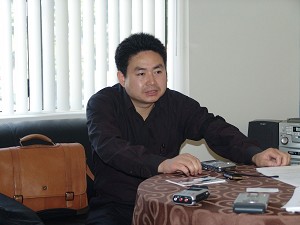
In the very early days of the 1989 student movement, the tiny and conservative University of Political Science and Law became the first school to march into Tiananmen Square and lay a wreath for Hu Yaobang. Zhou Yongjun, an undergraduate student from the school, participated in the march. He soon became a visible leader in the emerging movement. At the end of Hu Yaobang's funeral, he was one of the three students who staged an emotional kneeling petition on the stairs of the Great Hall of People.
When Liu Gang called a clandestine meeting to form the Beijing Students Autonomous Federation, the school sent the largest group of students in attendance. Largely based on that strength, Zhou Yongjun narrowly beat out Wuer Kaixi to become the first president for this new organization.
Zhou Yongjun's reign did not last long. He was immediately thrown under the unbelievable pressure on whether to persist on with the demonstration on April 27, when he finally succumbed and canceled the event in the wee hours of April 27. It did not matter. The most glorious demonstration happened anyway. Zhou Yongjun was left behind and lost his position as the president of Beijing Autonomous Federation.
He continued to work for the organization and helped organize another big demonstration on May 4. However, he made another mistake that day when he announced the end of class strike without a clear resolution within the leadership. In that aftermath, he was expelled from the organization altogether. But he stayed involved in the movement and participated in the student hunger strike.
In the latter stages of the movement, Zhou Yongjun drifted away from students and helped to establish the Workers Autonomous Federation in which he played a significant role in its propaganda work and media operation. During the night of the massacre, he was at Tiananmen Square and helped organize what resistance they could manage.
Zhou Yongjun was arrested in mid-June and stayed in jail for almost two years. After his release, he escaped the country and made his way to exile in Hong Kong and then the US. In 1998, he went back to China apparently for underground activities and was jailed for another three years.
In 2002, Zhou Yongjun managed to return to US. He then became deeply involved in a cult-ish sect practicing Qigong (中功), perhaps attempting to forge an unusual alliance.
There had been persistent rumors that he had disappeared during a personal trip to Hong Kong in late 2008. Most recently, the China Support Network reported that they had confirmed Zhou Yongjun's arrest for "financial fraud" by the Chinese government. The details of his current situation is however still lacking.
Update: on May 13, 2009, Reuters confirmed Zhou Yongjun's arrest in China.
Update: on January19, 2010, Zhou Yongjun was sentenced to nine years in prison.
Update: in January, 2011, Hong Kong Journal described Zhou Yongjun's legal case in detail.
Update: on December 6, 2015, Zhou Yongjun was released from prison early. He returned to his hometown in Sichuan.
Update: on December 6, 2015, Zhou Yongjun was released from prison early. He returned to his hometown in Sichuan.
Thursday, April 23, 2009
This Day in 1989: April 23, the Beijing Students Autonomous Federation is Formed
After the dramatic action at the funeral, Sunday, April 23, 1989, was a day of rest for most students. As their kneeling petition was ignored by the government, a consensus decision was made to launch a city-wide class strike in the coming weeks. Also on this day, General Secretary Zhao Ziyang left China for a pre-scheduled state visit to North Korea, leaving the domestic matters to Premier Li Peng.
At Peking University, Shen Tong and his friends rigged up a couple of loudspeakers outside of his dorm window at The Triangle and connected them with microphones and broadcasting equipments. The makeshift setup would grow into the very first makeshift student media center. Taking advantage of the set up, famed intellectual Chen Mingyuan (陈明远) delivered a passionate speech supporting students. The speech was recorded and duplicated with audiotapes and helped to inspire many more students into joining the movement.
Liu Gang spent the entire day to round up emerging student leaders he had privately identified from each campus and ushered them into his residence at Yuanmingyuan. In a small conference room that evening, he opened a clandestine meeting to form a new city-wide student organization. Under his guidance, Wuer Kaixi chaired the meeting. The Beijing Students Autonomous Federation was born.
For a hastily organized meeting, not all schools were properly represented. No established student leaders from Peking University attended. On the other hand, University of Political Science and Law demonstrated their strength with the biggest delegation. In a vote for its first president, that school's Zhou Yongjun narrowed beat Wuer Kaixi. They also decided that the presidency would be a rotating one.
Fearing for their safety, the meeting did not last long. In the coming days and weeks, however, the Beijing Students Autonomous Federation would take on a very public role in leading the movement.
Days of 1989
At Peking University, Shen Tong and his friends rigged up a couple of loudspeakers outside of his dorm window at The Triangle and connected them with microphones and broadcasting equipments. The makeshift setup would grow into the very first makeshift student media center. Taking advantage of the set up, famed intellectual Chen Mingyuan (陈明远) delivered a passionate speech supporting students. The speech was recorded and duplicated with audiotapes and helped to inspire many more students into joining the movement.
Liu Gang spent the entire day to round up emerging student leaders he had privately identified from each campus and ushered them into his residence at Yuanmingyuan. In a small conference room that evening, he opened a clandestine meeting to form a new city-wide student organization. Under his guidance, Wuer Kaixi chaired the meeting. The Beijing Students Autonomous Federation was born.
For a hastily organized meeting, not all schools were properly represented. No established student leaders from Peking University attended. On the other hand, University of Political Science and Law demonstrated their strength with the biggest delegation. In a vote for its first president, that school's Zhou Yongjun narrowed beat Wuer Kaixi. They also decided that the presidency would be a rotating one.
Fearing for their safety, the meeting did not last long. In the coming days and weeks, however, the Beijing Students Autonomous Federation would take on a very public role in leading the movement.
Days of 1989
Tuesday, April 21, 2009
This Day in 1989: April 21, Students Organize and March into Tiananmen Square
The stirring passion of the last few days ignited by Hu Yaobang's passing continued to develop on April 21, 1989. Seeing the courage of Wuer Kaixi at Xinhuamen, Liu Gang sought him out this morning to discuss the formation of a city-wide student leadership organization. They reached a general agreement.
Also on this day, some intellectuals joined in the fray and published open letters of their own to petition the government.
But the main action continued to be the students. In the late afternoon, thousands and thousands of them, from about twenty colleges in Beijing, gathered at Beijing Normal University. Wuer Kaixi displayed his natural leadership skills and guided the huge crowd into tight formations. He made a speech to proclaim the foundation of a "Beijing Provisional Student Union," which did not yet exist at the time, and led the students out of his campus toward Tiananmen Square. The demonstration surprised and delighted city residents who cheered them along the way.
The students reached Tiananmen Square around midnight. They settled down in front of the Great Hall of People, where Hu Yaobang's state funeral would commerce the next day. The area was scheduled to be closed in the morning for the occasion. But these tens of thousands of students made their claim. They would spend the cold spring night in the Square so that they could be a part of the funeral.
Days of 1989
Also on this day, some intellectuals joined in the fray and published open letters of their own to petition the government.
But the main action continued to be the students. In the late afternoon, thousands and thousands of them, from about twenty colleges in Beijing, gathered at Beijing Normal University. Wuer Kaixi displayed his natural leadership skills and guided the huge crowd into tight formations. He made a speech to proclaim the foundation of a "Beijing Provisional Student Union," which did not yet exist at the time, and led the students out of his campus toward Tiananmen Square. The demonstration surprised and delighted city residents who cheered them along the way.
The students reached Tiananmen Square around midnight. They settled down in front of the Great Hall of People, where Hu Yaobang's state funeral would commerce the next day. The area was scheduled to be closed in the morning for the occasion. But these tens of thousands of students made their claim. They would spend the cold spring night in the Square so that they could be a part of the funeral.
Days of 1989
Tuesday, December 23, 2008
Winston Lord Recalls His Days in China
In anticipation of the coming thirty-year anniversary of the normalization of relationship between China and the United States, the National Committee on United States - China Relations hosted a panel discussion, Once Upon a Time in Beijing, attended by five former U. S. Ambassadors to China, on December 9, 2008. The program was broadcast on C-SPAN and available on YouTube.
Near the beginning, at about the 11:45 mark, Ambassador Winston Lord, who was in China between 1985 and 1989, recalled one of his highlight/lowlight moment:
Winston Lord's visit to the Salon drew a big audience that day. Later in the day, a graduate student was killed in an apparent isolated violence off-campus. A small-scale student movement broke out for the occasion and Liu Gang, by the time no longer a student, was banned from the campus. The initial outdoor "Democracy Salon" was therefore interrupted but later resurrected by Wang Dan in his dormitory building.
In this panel discussion, Winston Lord proceeded to describe the incident when Fang Lizhi was forbid to attend a banquet hosted by visiting President George H. W. Bush as another lowlight of his time in Beijing.
Much later in the program, at about 1:07:30 mark, Winston Lord's successor James Lily gave an interesting account on the manuvers involved in getting Fang Lizhi out of China after he had taken refuge in the American embassy following the Tiananmen massacre.
Recollections of 1989
Near the beginning, at about the 11:45 mark, Ambassador Winston Lord, who was in China between 1985 and 1989, recalled one of his highlight/lowlight moment:
It was in June of 1988, a year before the Tiananmen, meeting with Chinese students, hundreds of them in what came to be known as the Democracy Salon and see their passion and their eagerness. It was a highlight, but also a lowlight. I have to elaborate this because a few days later Deng Xiaoping sent me a personal message to not to meet Chinese students.The "Democracy Salon" he referred to here was the one organized by Liu Gang and had been in weekly session by that point. It was held at a grass lawn in Peking University and regularly attracted dozens to hundres of students.
Winston Lord's visit to the Salon drew a big audience that day. Later in the day, a graduate student was killed in an apparent isolated violence off-campus. A small-scale student movement broke out for the occasion and Liu Gang, by the time no longer a student, was banned from the campus. The initial outdoor "Democracy Salon" was therefore interrupted but later resurrected by Wang Dan in his dormitory building.
In this panel discussion, Winston Lord proceeded to describe the incident when Fang Lizhi was forbid to attend a banquet hosted by visiting President George H. W. Bush as another lowlight of his time in Beijing.
Much later in the program, at about 1:07:30 mark, Winston Lord's successor James Lily gave an interesting account on the manuvers involved in getting Fang Lizhi out of China after he had taken refuge in the American embassy following the Tiananmen massacre.
Recollections of 1989
Tuesday, September 30, 2008
Wang Dan Calls For Commemorating Tiananmen Square Massacre
October 1 is the National Day of the People's Republic of China. On this day, Wang Dan released a statement calling for the preparation of a world-wide commemoration of the upcoming 20th anniversary of the Tiananmen massacre.
The statement, titled as "Commemorating June 4th, Recover Justice, Let China become the Safe Homeland for all Chinese", is cosigned by his fellow exiled leaders Wang Juntao, Hu Ping, Chen Yizi, Liu Gang, Xiang Xiaoji, Li Jinjin, and Li Hengqing. It proclaims the planning of a series of commemorative activities in Hong Kong, Washington DC, and all over the world, as well as the publication of books and art works. It also calls for volunteers to join the efforts.
The statement, titled as "Commemorating June 4th, Recover Justice, Let China become the Safe Homeland for all Chinese", is cosigned by his fellow exiled leaders Wang Juntao, Hu Ping, Chen Yizi, Liu Gang, Xiang Xiaoji, Li Jinjin, and Li Hengqing. It proclaims the planning of a series of commemorative activities in Hong Kong, Washington DC, and all over the world, as well as the publication of books and art works. It also calls for volunteers to join the efforts.
Tuesday, July 1, 2008
"Chinese Democracy"
TIME's Joel Stein wrote this about the Guns n' Roses album:
Liu Gang got married this past weekend. Wang Juntao and Wang Dan were there to serve as his best men and, in Wang Juntao's words, send Liu Gang off for "a different kind of life". The wedding was a small, elegant, and loving affair.
In a quiet moment at the pre-wedding dinner, after other guests had departed, the three of them raised their glasses for their shared experience and friendship. Suddenly, Liu Gang sighed, "We now have everything we ever wanted. The only thing missing is this Chinese democracy..." He did not finish his sentence. The room was suddenly very silent.
Today is the official anniversary of the Chinese Communist Party, which was founded during this month 87 years ago. It came to power in China almost 60 years ago, partly due to its military strength and partly on its own promise to bring democracy to the Chinese people. More than half a century later, people are still waiting.
Would it be nice, if Chinese Democracy could be made for easy download, legally or otherwise, like the album with the same name?
I have Chinese Democracy. This is the Guns n' Roses album that lead singer Axl Rose has devoted himself to working on for 14 years, the same amount of time it took to carve Mount Rushmore. More than $13 million is reported to have been spent so far to make it, way more than any other album ever. It still has no formal release date. Every few years Rose assures his fans that it's about to be released, and then it isn't. It's gotten so ridiculous that the album title is used to mean something that is long promised but will never happen, like "That marriage proposal is total Chinese Democracy. Move on, girl."I have never heard the term "Chinese Democracy" used this way. But then again, I am not a music or art kind of person. Yet how fitting it could/would be? That Chinese Democracy -- the real thing, not the album -- is something that had had been long promised but yet to happen?
Liu Gang got married this past weekend. Wang Juntao and Wang Dan were there to serve as his best men and, in Wang Juntao's words, send Liu Gang off for "a different kind of life". The wedding was a small, elegant, and loving affair.
In a quiet moment at the pre-wedding dinner, after other guests had departed, the three of them raised their glasses for their shared experience and friendship. Suddenly, Liu Gang sighed, "We now have everything we ever wanted. The only thing missing is this Chinese democracy..." He did not finish his sentence. The room was suddenly very silent.
Today is the official anniversary of the Chinese Communist Party, which was founded during this month 87 years ago. It came to power in China almost 60 years ago, partly due to its military strength and partly on its own promise to bring democracy to the Chinese people. More than half a century later, people are still waiting.
Would it be nice, if Chinese Democracy could be made for easy download, legally or otherwise, like the album with the same name?
Saturday, June 21, 2008
NYT Archive 1989: Death Toll Reassessed
More than two weeks after the massacre, New York Times on June 21, 1989, reassessed the death toll of the crackdown:
In the same issue, NYT reported the arrest of Liu Gang:
The death toll estimation was based on numbers compiled from hospitals nearest Tiananmen Square, detailed in the article itself.The true number of deaths will probably never be known, and it is possible that thousands of people were killed without leaving evidence behind. But based on the evidence that is now available, it seems plausible that about a dozen soldiers and policemen were killed, along with 400 to 800 civilians.Some of the early estimates of thousands of deaths, including the American estimate, were based on reports that the Chinese Red Cross had counted 2,600 deaths. But the Chinese Red Cross has denied saying any such thing, and this seems to have been an offshoot of two other rumors that variously used the figure of 2,600 to describe the number of students who were missing and the number of students who were killed.
In the same issue, NYT reported the arrest of Liu Gang:
Several days earlier, NYT had also reported that Ma Shaofang had turned himself in.The television announced that Mr. Liu was arrested in the city of Baoding, 90 miles southwest of Beijing, where he was hiding in a park while awaiting a train to a more distant city.''Local policemen found him, and were suspicious, so they took him to the police station,'' the television announcer said. ''Liu Gang was in shabby clothes and used the assumed name of Zhang Shun. He said he was a laborer, but the policemen saw that he had no thick callouses on his hands and that he had pale skin and that he didn't have the air of a laborer. So the police questioned him further, and he confessed.''Like most of the other students who have been arrested, Mr. Liu appeared calm and composed during his interrogation. There were no obvious signs that he had been beaten, as many of the workers seem to have been by the time they are shown on television.
Sunday, June 15, 2008
NYT Archive 1989: 21 Most Wanted
The 21 Most Wanted student leaders were announced by the Chinese government and reported by New York Times on June 14, 1989:
The list: Wang Dan, Wuer Kaixi, Liu Gang, Chai Ling, Zhou Fengsuo, Zhai Weiming (翟伟民), Liang Jindun (梁擎墩), Wang Zhengyun (王正云), Zheng Xuguang (郑旭光), Ma Shaofang (马少方), Yang Tao, Wang Zhixin (王志新), Feng Congde, Wang Chaohua, Wang Youcai (王有才), Zhang Zhiqing (张志清), Zhang Boli (张伯笠), Li Lu (李禄), Zhang Ming (张铭), Xiong Wei (熊炜), and Xiong Yan.
As Liu Gang would later comment, almost all of the 21 had been, one way or another, involved with the Beijing Students Autonomous Federation he had founded.
The 21 students whose mug shots and biographical details were shown on television included the two most prominent leaders of the democracy movement, Wang Dan and Wuer Kaixi. Others shown on television were Chai Ling, the leader of the students occupying Tiananmen Square, and her husband, Feng Congde, and a 28-year-old graduate student, Liu Gang, who is said to have assisted the students from behind the scenes.From NYT's description above, it is clear that Liu Gang's significance in the movement was not understood by outsiders. Even most students were surprised seeing his name in the no. 3 slot, behind Wang Dan and Wuer Kaixi but ahead of Chai Ling.
The television showed lengthy film clips of Mr. Wuer, apparently so that viewers could identify him and turn him in. The clips also showed the extent of Government surveillance of the student leaders; it seemed that three different video cameras were used to record one visit by Mr. Wuer on May 29 to a restaurant in a Beijing hotel. One camera was trained on him from above while he ate, another showed him leaving the restaurant, and a third caught him as he left the building.
The list: Wang Dan, Wuer Kaixi, Liu Gang, Chai Ling, Zhou Fengsuo, Zhai Weiming (翟伟民), Liang Jindun (梁擎墩), Wang Zhengyun (王正云), Zheng Xuguang (郑旭光), Ma Shaofang (马少方), Yang Tao, Wang Zhixin (王志新), Feng Congde, Wang Chaohua, Wang Youcai (王有才), Zhang Zhiqing (张志清), Zhang Boli (张伯笠), Li Lu (李禄), Zhang Ming (张铭), Xiong Wei (熊炜), and Xiong Yan.
As Liu Gang would later comment, almost all of the 21 had been, one way or another, involved with the Beijing Students Autonomous Federation he had founded.
Subscribe to:
Posts (Atom)