This does not appear to be a most recent development but was made public only this month. Chai Ling, the former leader of the 1989 student movement, and her husband are suing the producers of the documentary Gate of Heavenly Peace for deformation and trademark infringement. China Beat carried a lengthy interview with Geremie R. Barme on the details of the case.
On the web site for the documentary itself, there are new pages spelling out an appeal on the ground of freedom of speech on this issue. The appeal takes the form of an open letter and is cosigned by the producers as well as more than a hundred supporting signatories, most of them are faculty members specializing in China affairs. The author is calling for more signatures of support.
Mr. Barme believes the lawsuit, which started a couple of years ago, is an attempt to silence the documentary and its web site, which contains material which could be viewed as negative to Chai Ling's reputation. He indicates that the deformation suit has already been thrown out of the court but the trademark infringement suit was allowed to continue. Under the pressure of mounting legal fees, the non-profit organization behind the documentary and the web site might be forced to close.
The documentary Gate of Heavenly Peace has caused great controversy since its release in 1995. Most of the dispute centered on its highlighted use of Chai Ling's videotaped "Last Word" speech in which she indicated that she was "hoping for bloodshed" ("期待流血") while she was planning to survive herself. There have been different accounts on the circumstances of the taping as the recorder Phillip Cunningham and Chai Ling's ex-husband and fellow student leader Feng Congde each provided conflicting background information.
Chai Ling's videotape has also been extensively described in my own book, Standoff at Tiananmen.
Sunday, April 26, 2009

This Day in 1989: April 26
In the morning of April 26, 1989, the newly formed Beijing Students Autonomous Federation held its first public press conference at University of Political Science and Law. In front of some fifty most foreign reporters, they announced that a mass demonstration would be held next morning to protest the People's Daily editorial. Announcements with assembly instructions appeared in numerous campuses.
In the afternoon, thousands of bureaucrats within the government apparatus and college leadership gathered in the Great Hall of People for an emergency meeting on the developing situation. They were instructed to do everything they could in persuading and preventing students from going out of campus the next day. The tension was building.
That evening, Zhou Yongjun, the first president of Beijing Students Autonomous Federation was holed up in a room by a few handlers from the school. They pressured him to cancel the demonstration. Zhou Yongjun resisted the best he could, but finally cracked in the early morning hours of April 27. He could not be held responsible for the safety of the thousands of students. His handlers obtained a signed decree of cancellation and immediately dispatched vehicles to deliver it to other campuses.
At Beijing Normal University, Wuer Kaixi experienced the same pressure and came to the same conclusion almost at the same time. His handlers sent him to Peking University in person to advice the students there of the cancellation.
In the meantime, student leader Ma Shaofang had heard of rumors of a military crackdown. He
was shuffling through campuses in an attempt to gather enough Federation delegates for an emergency meeting to make a formal go-no-go decision. He failed in that mission. Near midnight, at Peking University, he and Wang Dan agreed to let the demonstration go ahead as scheduled.
Days of 1989
Saturday, April 25, 2009
Document of 1989: People's Daily Editorial
In the evening of April 25, 1989, a People's Daily editorial was widely broadcast in all official media in China. The editorial was then published in the morning edition of April 26 and became known as the April 26 People's Daily editorial.
 It was only the very early days of the student movement when students were trying hard to maintain their stance as "pure", democratic, and patriotic. Yet the editorial had already characterized the movement as turmoil, a planned conspiracy, and other familiar terms aimed at enemies of the state.
The content of the editorial was based on an unpublished speech by Deng Xiaoping himself. While away in North Korea on a state visit, General Secretary Zhao Ziyang approved its publication by telegram.
The harsh wording of the editorial had an immediate and devastating effect on students, who, after much dramatic struggle, responded with the biggest demonstration on April 27. In the following weeks, recalling the editorial became a focal point in students' demands. There were credible hints from Zhao Ziyang and his camp within the leadership, and arguably from Deng Xiaoping himself, that they were willing to yield from the tough stance of the editorial. But none of them could make that decision formal and official. The deadlock on the editorial eventually triggered a hunger strike by students, martial law by the government, and drove the standoff into a tragic massacre.
The following English translation of the editorial was from the official Foreign Broadcast Information Service and taken from the Gate of Heavenly Peace website:
Documents of 1989
 It was only the very early days of the student movement when students were trying hard to maintain their stance as "pure", democratic, and patriotic. Yet the editorial had already characterized the movement as turmoil, a planned conspiracy, and other familiar terms aimed at enemies of the state.
The content of the editorial was based on an unpublished speech by Deng Xiaoping himself. While away in North Korea on a state visit, General Secretary Zhao Ziyang approved its publication by telegram.
The harsh wording of the editorial had an immediate and devastating effect on students, who, after much dramatic struggle, responded with the biggest demonstration on April 27. In the following weeks, recalling the editorial became a focal point in students' demands. There were credible hints from Zhao Ziyang and his camp within the leadership, and arguably from Deng Xiaoping himself, that they were willing to yield from the tough stance of the editorial. But none of them could make that decision formal and official. The deadlock on the editorial eventually triggered a hunger strike by students, martial law by the government, and drove the standoff into a tragic massacre.
The following English translation of the editorial was from the official Foreign Broadcast Information Service and taken from the Gate of Heavenly Peace website:
IT IS NECESSARY TO TAKE A CLEAR-CUT STAND AGAINST DISTURBANCES
In their activities to mourn the death of Comrade Hu Yaobang, communists, workers, peasants, intellectuals, cadres, members of the People's Liberation Army and young students have expressed their grief in various ways. They have also expressed their determination to turn grief into strength to make contributions in realizing the four modernizations and invigorating the Chinese nation.
Some abnormal phenomena have also occurred during the mourning activities. Taking advantage of the situation, an extremely small number of people spread rumors, attacked party and state leaders by name, and instigated the masses to break into the Xinhua Gate at Zhongnanhai, where the party Central Committee and the State Council are located. Some people even shouted such reactionary slogans as, Down with the Communist Party. In Xi'an and Changsha, there have been serious incidents in which some lawbreakers carried out beating, smashing, looting, and burning.
Taking into consideration the feelings of grief suffered by the masses, the party and government have adopted an attitude of tolerance and restraint toward some improper words uttered and actions carried out by the young students when they were emotionally agitated. On April 22, before the memorial meeting was held, some students had already showed up at Tiananmen Square, but they were not asked to leave, as they normally would have been. Instead, they were asked to observe discipline and join in the mourning for Comrade Hu Yaobang. The students on the square were themselves able to consciously maintain order. Owing to the joint efforts by all concerned, it was possible for the memorial meeting to proceed in a solemn and respectful manner.
However, after the memorial meeting, an extremely small number of people with ulterior purposes continued to take advantage of the young students' feelings of grief for Comrade Hu Yaobang to spread all kinds of rumors to poison and confuse people's minds. Using both big- and small-character posters, they vilified, hurled invectives at, and attacked party and state leaders. Blatantly violating the Constitution, they called for opposition to the leadership by the Communist Party and the socialist system. In some of the institutions of higher learning, illegal organizations were formed to seize power from the student unions. In some cases, they even forcibly took over the broadcasting systems on the campuses. In some institutions of higher learning, they instigated the students and teachers to go on strike and even went to the extent of forcibly preventing students from going to classes, usurped the name of the workers' organizations to distribute reactionary handbills, and established ties everywhere in an attempt to create even more serious incidents.
These facts prove that what this extremely small number of people did was not to join in the activities to mourn Comrade Hu Yaobang or to advance the course of socialist democracy in China. Neither were they out to give vent to their grievances. Flaunting the banner of democracy, they undermined democracy and the legal system. Their purpose was to sow dissension among the people, plunge the whole country into chaos and sabotage the political situation of stability and unity. This is a planned conspiracy and a disturbance. Its essence is to, once and for all, negate the leadership of the CPC and the socialist system. This is a serious political struggle confronting the whole party and the people of all nationalities throughout the country.
If we are tolerant of or conniving with this disturbance and let it go unchecked, a seriously chaotic state will appear. Then, the reform and opening up; the improvement of the economic environment and the rectification of the economic order, construction, and development; the control over prices; the improvement of our living standards; the drive to oppose corruption; and the development of democracy and the legal system expected by the people throughout the country, including the young students, will all become empty hopes. Even the tremendous achievements scored in the reform during the past decade may be completely lost, and the great aspiration of the revitalization of China cherished by the whole nation will be hard to realize. A China with very good prospects and a very bright future will become a chaotic and unstable China without any future.
The whole party and the people nationwide should fully understand the seriousness of this struggle, unite to take a clear-cut stand to oppose the disturbance, and firmly preserve the hard-earned situation of political stability and unity, the Constitution, socialist democracy, and the legal system. Under no circumstances should the establishment of any illegal organizations be allowed. It is imperative to firmly stop any acts that use any excuse to infringe upon the rights and interests of legitimate organizations of students. Those who have deliberately fabricated rumors and framed others should be investigated to determine their criminal liabilities according to law. Bans should be placed on unlawful parades and demonstrations and on such acts as going to factories, rural areas, and schools to establish ties. Beating, smashing, looting, and burning should be punished according to law. It is necessary to protect the just rights of students to study in class. The broad masses of students sincerely hope that corruption will be eliminated and democracy will be promoted. These, too, are the demands of the party and the government. These demands can only be realized by strengthening the efforts for improvement and rectification, vigorously pushing forward the reform, and making perfect our socialist democracy and our legal system under the party leadership.
All comrades in the party and the people throughout the country must soberly recognize the fact that our country will have no peaceful days if this disturbance is not checked resolutely. This struggle concerns the success or failure of the reform and opening up, the program of the four modernizations, and the future of our state and nation. Party organizations of the CPC at all levels, the broad masses of members of the Communist Party and the Communist Youth League, all democratic parties and patriotic democratic personages, and the people around the country should make a clear distinction between right and wrong, take positive action, and struggle to firmly and quickly stop the disturbance.
Documents of 1989
This Day in 1989: April 25, Students Decide to Plan a March
Students in Beijing continued their class strike to its second day on April 25, 1989. They spent their free time going on streets in small groups to publicize their petitions and protests. On campus, they were also busy establishing their own independent organizations. Although only a couple of days old, the Preparatory Committee at Peking University was already going through a series of reorganizations amid personnel confusion and infighting.
In the afternoon, a group of leaders from the State Council, the National Education Commission, and the Beijing city government showed up at Tsinghua University for a dialogue with students, auspiciously at the invitation of Tsinghua students. The news caused a big chaos on that campus. Fearing for being singled out to betray the movement, Tsinghua students boycotted the dialogue and its new independent student union practically dissolved with mass resignations.
In Shanghai, a vocal newspaper World Economics Herald published the proceedings of a symposium in which prominent intellectuals voiced their sympathy for Hu Yaobang. The paper was being recalled.
But the main actions continued to center in Beijing. The newly formed Beijing Students Autonomous Federation held its first general meeting at University of Political Science and Law. In a somewhat clandestine atmosphere, hundreds of student delegates debated on the merit of a plan to hold a large-scale demonstration on April 27. It was during a break of this meeting in the evening when students heard the first broadcast of the People's Daily editorial, to be published next day on April 26, which labeled the movement as a "planned conspiracy" and "turmoil."
Days of 1989
Friday, April 24, 2009
This Day in 1989: April 24, At Peking University, the Preparatory Committee Experiences its First Setback
Monday, April 24, 1989, was the first day of the city-wide class strike for almost all colleges in Beijing. While not going to classes, students kept themselves busy in organizing their own solidarity unions.
In that afternoon, the Preparatory Committee at Peking University called for a formal student assembly at an athletic field on campus. Thousands of students attended to dissolve the official student union and vote for their own. The enthusiasm did not last long, however. It soon became clear that there was open rift among the personnel in the leadership committee. They fought for microphone and accused each other as moles. The meeting deteriorated and most student audience walked out in disgust.
At Beijing Normal University, things went a lot smoother. the charismatic Wuer Kaixi was chosen as the president of its own solidarity student union.
Days of 1989
Thursday, April 23, 2009
This Day in 1989: April 23, the Beijing Students Autonomous Federation is Formed
After the dramatic action at the funeral, Sunday, April 23, 1989, was a day of rest for most students. As their kneeling petition was ignored by the government, a consensus decision was made to launch a city-wide class strike in the coming weeks. Also on this day, General Secretary Zhao Ziyang left China for a pre-scheduled state visit to North Korea, leaving the domestic matters to Premier Li Peng.
At Peking University, Shen Tong and his friends rigged up a couple of loudspeakers outside of his dorm window at The Triangle and connected them with microphones and broadcasting equipments. The makeshift setup would grow into the very first makeshift student media center. Taking advantage of the set up, famed intellectual Chen Mingyuan (陈明远) delivered a passionate speech supporting students. The speech was recorded and duplicated with audiotapes and helped to inspire many more students into joining the movement.
Liu Gang spent the entire day to round up emerging student leaders he had privately identified from each campus and ushered them into his residence at Yuanmingyuan. In a small conference room that evening, he opened a clandestine meeting to form a new city-wide student organization. Under his guidance, Wuer Kaixi chaired the meeting. The Beijing Students Autonomous Federation was born.
For a hastily organized meeting, not all schools were properly represented. No established student leaders from Peking University attended. On the other hand, University of Political Science and Law demonstrated their strength with the biggest delegation. In a vote for its first president, that school's Zhou Yongjun narrowed beat Wuer Kaixi. They also decided that the presidency would be a rotating one.
Fearing for their safety, the meeting did not last long. In the coming days and weeks, however, the Beijing Students Autonomous Federation would take on a very public role in leading the movement.
Days of 1989
Wednesday, April 22, 2009
Place of 1989: Beijing Normal University
The precursor of Beijing Normal University was established near the turn of last century with a declared purpose of educating future teachers. As an old institute that shared the same ancestor and tradition with the older Peking University, Beijing Normal University had seen her own share of student movement in the troubled history of modern China. Most significantly for this school, three of her students were killed in a peaceful demonstration on March 18, 1926, which was remembered as the "March 18 Massacre."
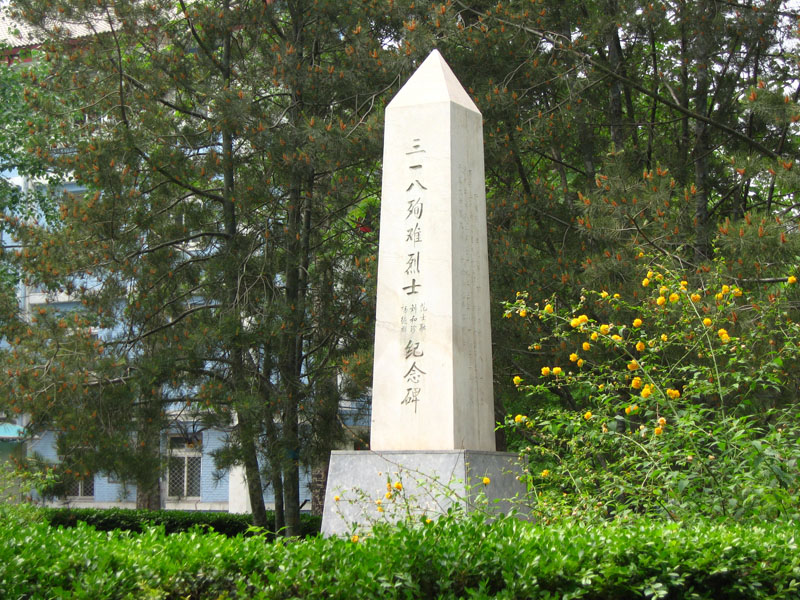
That historical event was commemorated on campus with an elegant statue, a landmark where more recent students gathered for their own demonstrations.
During the 1980s, Beijing Normal University was a relatively tranquil place and not known for her student activism. Until 1989, that was.
In the very early days of the 1989 student movement, Wuer Kaixi, an undergraduate student from this school, stood up and demonstrated his ample leadership skills. He would become known as the most charismatic leader throughout the movement, even after his own mistakes had led to his banishment from the student leadership. Surrounding him, other students from this small school, such as Cheng Zhen (程真) and Liang Qingdun (梁擎墩), also played important leadership roles in the movement.
Student leader Chai Ling was also a graduate student at Beijing Normal University during the movement time. But she lived and participated in her undergraduate alma mater, Peking University, instead.
At the late stage of the movement, it was a young professor from this school, Liu Xiaobo, who became a focal point. Together with Gao Xin (高新), the editor of the school's newspaper, Liu Xiaobo launched a hunger strike of his own. In the fateful early morning of June 6, 1989, it was the voice of these older intellectuals that helped persuade students into their final withdraw from Tiananmen Square.
Subscribe to:
Posts (Atom)