The following excerpt is from my book Standoff at Tiananmen, chapter 4, describing the scene of students participating in Hu Yaobang's state funeral on April 22, 1989. The same excerpt had previously appeared on Danwei.
Substantial police forces did show up at daybreak. They built up a human barrier in front of the Great Hall of People. From there they watched the students intently but otherwise showed no desire to evict them out of the Square.
Just before sunrise, a platoon of honor guards marched out of Tiananmen, crossed Chang'an Avenue, and entered the Square from its northern edge. It was the time for the traditional flag-raising ceremony. As they stopped at the giant National Flag Pole, the hundreds of thousands of students stood at attention. They turned to face the rising Five-Starred Red Flag, singing the national anthem at the top of their lungs:
Arise! All who refuse to be slaves!
Let our flesh and blood
Become our new Great Wall!
As the Chinese nation faces its greatest peril,
All forcefully expend their last cries.
Arise! Arise! Arise!
May our million hearts beat as one,Brave the enemy's fire,March on!Brave the enemy's fire,March on!March on! March on! On!Originally composed as the theme song for a patriotic movie during the anti-Japanese war era, "March of Volunteers" was a rousing anthem inspired by "La Marseillaise". Even in peacetime, the sense of grandiosity, urgency, and even desperation of the song was enough to cause one's blood to boil. Now, at the center of the nation, defying their own government, hundreds of thousands of students were singing the anthem in one voice. It was a moment of great crisis, uncertainty, and hope. Most of them had tears in their eyes. Looking at the rising flag, they wondered how this day would end.
The anthem finished just as the flag reached the top of the pole. Then, it began an agonizingly slow decent. As it settled into a half-staff position in honor of Hu Yaobang, students sang the somber L'Internationale. The aggressive fighting spirit was replaced by a strong sense of sadness as more tears were shed.
In the crowd, Chai Ling was feeling an unprecedented sense of togetherness. She made a mental note of how many of her friends were present. She also spotted an unexpected figure: a die-hard Communist Party member who had worked hard to prevent students from protesting. But there he was, participating in this historical event with nothing but sincerity.
The sheer size and determination of the students must have impressed the authorities as well. Several officers came down from the long flights of stairs of the Great Hall to meet with student leaders in the early morning. As a good-will gesture, they allowed the students to remain in the Square for the duration of the funeral service. The service would also be broadcast live through the loudspeakers in the Square for their benefit. Predictably, however, they denied students' request to have their own representatives attending the service inside the Great Hall. Finally, the officials requested students to back away to make room for arriving vehicles. Under the guidance of Wuer Kaixi's bullhorn, the huge crowd grudgingly complied with discipline. Wishful but unfounded rumors were spreading that Premier Li Peng had agreed to meet with students after the funeral.
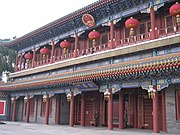
The Great Hall of People was one of the cornerstone masterpieces constructed during the renovation of Tiananmen Square in the 1950s. It was designed to host mass conferences typical in the communist political scene. It consisted of an auditorium that could seat ten thousand people and many palace-style meeting halls for receiving foreign dignitaries as well as domestic visitors. Symbolically, it was also the site of the National People's Congress which met here annually in the spring. It was built with an architecture of Stalinist grandiosity and covered an area of forty three acres. A dozen solemn pillars, each eighty-two feet high, dominated the front face. They supported an expanded eave decorated with a National Emblem, establishing the building as the symbol of the highest power of the land. Underneath, a long and majestic set of stairs, divided into three tiers, led to its front gates.
The memorial service commenced inside the Great Hall as the clock struck ten. Curiously, all top officials wore traditional "Mao Suits" to bid farewell to the man who had abolished the attire. Zhao Ziyang delivered a eulogy filled with familiar and impersonal praises. As the National Anthem was played inside and broadcast on the loudspeakers outside, students sang once again. They sang with their greatest devotion and force, hoping that their collective voice could carry enough power to penetrate the granite walls of the Great Hall. Then, they bowed their heads to observe a moment of silence.
Although their voices might not have been heard, their presence was undoubtedly felt by everyone inside. Ge Yang, a prominent magazine editor, observed:
After Zhao Ziyang delivered the eulogy for Hu Yaobang, we filed past to pay our last respects. As we walked by the glass doors of the Great Hall of People, many lingered for a moment to observe the many thousands of students sitting outside on the Square. Rows of soldiers stood with arms linked to separate the students from us. I felt rage as I stood there silently watching them. The atmosphere was tense. Some of the officials feared that the students might try to force their way into the Great Hall. A soldier came over and asked me politely to move on.
My driver walked up to me and took my arm. I replied, "I just want to stand here for a while. I belong to the Communist Party, and I was wounded serving the Party during the war. I have seen much, but I have never before seen such abuse of students by Party members like yourself."
The soldier listened and then left.
Referring to the rows of soldiers separating the students from the dignitaries inside the Great Hall, Ge Yang noted in a poem that "a wall of brute force" had split the land into two sides. "On one side lay Hu Yaobang's body, but on the other side was his soul."
Inside the Great Hall, Hu Yaobang's body was lying in state covered with the flag of the Communist Party. Officials and dignitaries walked past slowly to pay their last respects. At the end of the service, as tradition dictated, the funeral procession carrying the body would exit the Great Hall, circle Tiananmen Square, and then head west on Chang'an Avenue for the crematorium in the suburb. As funeral music played endlessly from the loudspeakers, students in the Square eagerly but patiently waited for the sight of the hearse. It was their own chance to bid farewell to Hu Yaobang.
It had been a long night and morning. As the farewell process dragged on inside, many decided that they had fulfilled their desire and mission. They trickled out of the Square for food and rest. But a few thousand persisted. They crowded toward the Great Hall of People to get a peek of the hearse.
It was after another long wait when word came that the funeral possession had already been spotted on Chang'an Avenue heading west. Along the boulevard, millions of residents lined the sidewalks to give Hu Yaobang a dignified send-off. Tens of thousands of bicycles followed the hearse on the side, ringing their bells. It was a scene reminiscent of that for late Premier Zhou Enlai in 1976. But this time, the hearse had skipped Tiananmen Square where thousands of students had been waiting.
A small chant emerged from the angry crowd and gradually grew into a roar:
"Li Peng! Come out!"
"Li Peng! Come out!"
The crowd surged forward. Soldiers, with their arms interlocked, struggled to hold their lines. At the forefront was Wuer Kaixi, still with the bullhorn in his hand, calling for Premier Li Peng.
"Look," screamed Wuer Kaixi, "so many students have starved for a whole day just for the opportunity to talk to you." He shouted, "after forty years of the People's Republic, this is the first time a man has stood under the National Emblem, in front of the Great Hall of People, in front of the highest authority of the land, and demanded a dialogue with you. I protest! You are shameless!"
Wuer Kaixi's statement was not historically accurate. Calling out national leaders in front of the Great Hall of People was far from an invention of this new generation. It had happened many times during the turmoil of the Cultural Revolution. Even more recently, Chen Ziming and Wang Juntao had witnessed the same scene during the April Fifth Movement in 1976. Yet Wuer Kaixi was certainly sincere in his sentiment. The young students never had the chance to receive a proper education of this part of history and they believed without a doubt that they were making an effort that nobody had ever made before.
It did not take long for some hot heads to suggest that they could push through the soldiers and storm the Great Hall. Surveying the numbers, Wuer Kaixi thought that they had a decent chance. But fortunately, just as he was going to yell into his bullhorn, others prevailed in stopping him. After a heated discussion, they decided to send in representatives with their Seven-Point Petition, to which they still had not received any response. "If they still ignore us, we will just kneel down in front of them!" suggested an emotional Zhang Boli. Kneeling, of course, was the traditional protocol for meeting an emperor. Zhang Boli proposed the dramatic gesture as a symbolic protest.
"No way! I don't want to kneel down in front of the communists!" replied a terse Wuer Kaixi.
"If you don't, I will!" Guo Haifeng, who had been a part of the previous petitions with Wang Dan and then Li Jinjin, grabbed the petition paper and headed to the Great Hall of People. Two others, Zhou Yongjun and Zhang Zhiyong, followed him. Perhaps caught by surprise, the soldiers let them sneak through.
It was about half past noon. The three of them marched onto the middle tier of the long flight of stairs. They looked around. There was nobody nearby. Down below at a distance that seemed far away, thousands of students stood behind lines of soldiers. Most of the students were not aware of the plan but their attention was fixed after spotting three figures ascending the stairs. Still ahead and higher up, the giant doors to the Great Hall of People remained closed. There were only a few guards at the top of the stairs looking down at them.
Slowly, Guo Haifeng lowered himself to his knees. On his left, Zhou Yongjun followed reluctantly but only knelt with his right leg. On his right, Zhang Zhiyong knelt down with both knees and buried his head into his chest. But Guo Haifeng looked up in defiance despite his body position. He raised both arms holding the long scroll of petition paper over his head toward the National Emblem high above.
A shock wave propagated down the stairs and through the student body in the Square. A brief silence was immediately overcome by horrified cries and screams.
"No!" "No!"
"You can't kneel down! Stand up!!!"
Perhaps for the first time in their young lives, this new generation vividly felt that they and their government were not on the same side. The drama was so intense that nobody knew how to react to it. The three of them knelt there for as long as half an hour. Nobody came out of the Hall to receive or reject them. It felt like an eternity.