For almost two decades, the Tiananmen Mothers have been collecting and documenting the victims of the Tiananmen massacre, despite of constant government surveillance and harassment. Their efforts have resulted to a list of 189 deaths of confirmed deaths. In this list, 71 were students, ranging from elementary school to graduate school ones.
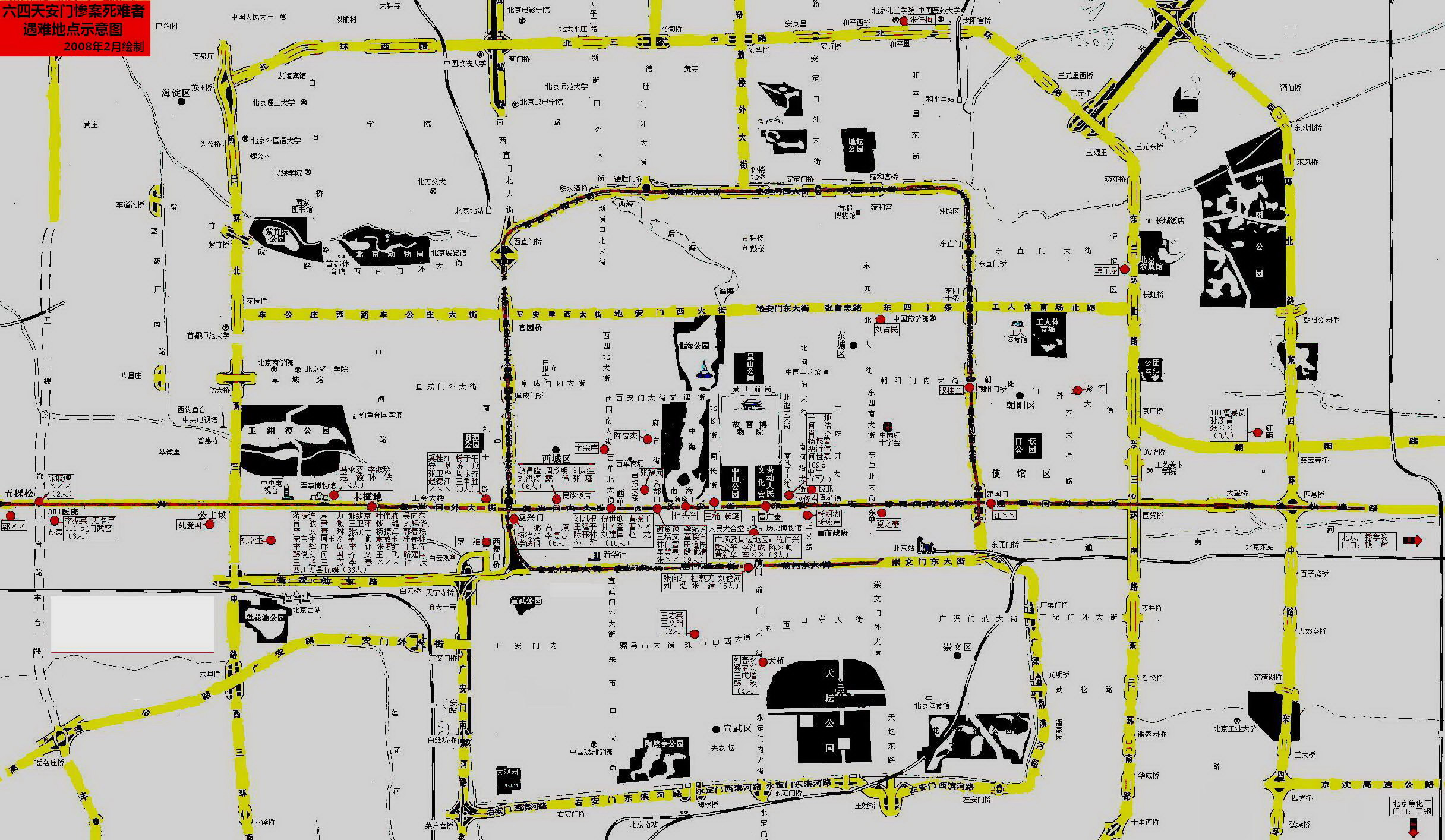
They were also able to identify the exact locations for 134 deaths. At the 19th anniversary of the tragedy, they published detailed maps showing where they had fallen (the map is annotated in Chinese):
Map of the Fallen Victims
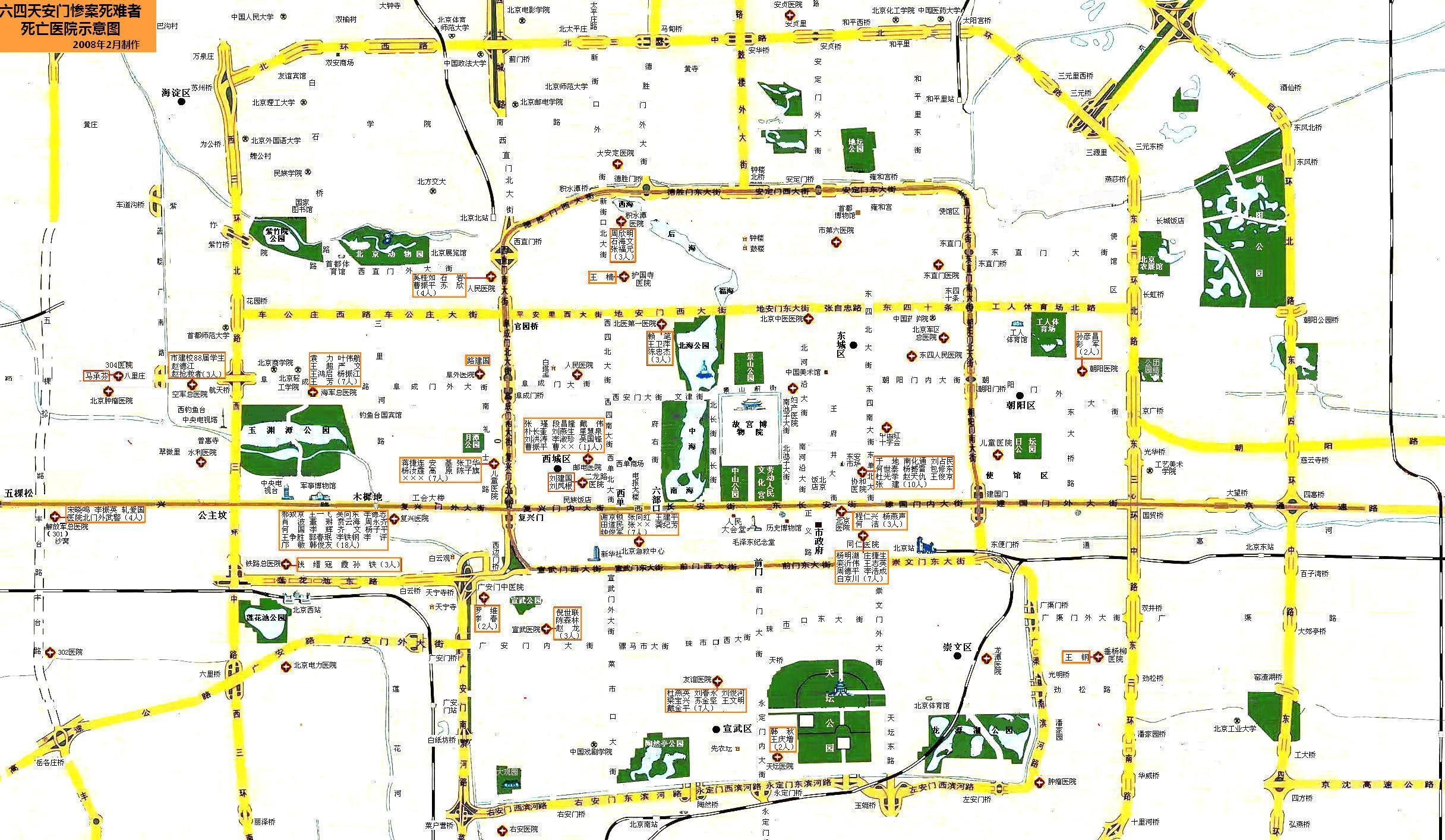
An accompanying map shows the hospitals where the dead were collected:
Map of Hospitals
The first map clearly indicated that the worst fighting happened along the Chang'an Avenue to the west of the Square, where the Beijing residents had put up the most stingiest resistance and where the troops showed the worst violence. Entering the city from the west, the troops killed 2 people in the outskirt, 4 in front of the Military Museum, 36 at the Muxudi intersection, 10 before Fuxinmen, and 5 at Fuxinmen intersection. Continuing inside downtown, they killed 6 near the Peoples Hotel, 10 at Xidan, and 9 at Liubukou. Most of the 9 at Liubukou, however, were killed after the troops had encircled Tiananmen Square and students had withdrawn. In a nightmarish maneuver, an armed personnel carrier charged into crowed and mauled over many on bikes and foot.
In all, more than 80 people perished along the west Chang'an Avenue. In contrast, there were only 6 confirmed deaths in and around the Square itself.
The list of 189 confirmed by Tiananmen Mothers is certainly an incomplete one. It also did not include deaths within the military troop. But among the various numbers that had been reported in the media, it might be the one closer to reality.
Wednesday, June 4, 2008

NYT Archive 1989: Crackdown
As troops opened fire in Beijing nineteen years ago, New York Times' series reports changed from "Upheaval in China" to "Crackdown in China". But on that day, not much reporting actually made it before the deadline. No death toll was given. There was not yet a comprehensive coverage of the crackdown itself, saving a "reporter's notebook" by Nicholas Kristof:
As the brief history of this movement was outlined, NYT also published an extensive report on the reasons behind it. The lengthy piece was obviously written before the crackdown and being published for the Sunday edition.
President George H. W. Bush and other American officials immediately condemned the crackdown. 300 people sieged on the Chinese Consulate at New York. More reactions were seen in Hong Kong and Taiwan. In Taiwan particularly, on the day their President acknowledged Communist control of China, the events and tragedy at Tiananmen were actually bringing people across the strait together.The violence against students and workers in Tiananmen Square was most obvious today, because for the most part they were the ones getting killed. But they, too, were violent against the police and army troops, although less effectively so.Clutching iron bars and bricks, the students glared at soldiers 100 yards away on the other side of the square. It was dark, although the fire from an armed personnel carrier that students had set ablaze cast an eerie glow over part of the square, and the troops and their rows of vehicles could be dimly discerned in the haze.From time to time, a group of them would advance on the soldiers to throw rocks and otherwise harass them. And then often, they would be shot and killed. It was an unequal competition.Whenever the students got their chance, spotting an unarmed group of soldiers, they attacked with bricks and iron bars. However, the soldiers, most of whom had guns, tended to stick together.Until now, students had emphasized the need for nonviolent tactics, and today some still begged their friends to put down their bricks and iron bars. But many students seemed to have crossed their personal Rubicon today, and those who previously had clutched leaflets and megaphones today picked up firebombs.
As the brief history of this movement was outlined, NYT also published an extensive report on the reasons behind it. The lengthy piece was obviously written before the crackdown and being published for the Sunday edition.
Tuesday, June 3, 2008
Pu Zhiqiang Not Allowed To Visit Tiananmen
Nineteen years ago, when Pu Zhiqiang (浦志强) left Tiananmen Square with his fellow students under the gunshots of the advancing martial law troops, he vowed to return to the Square every year on this day to commensurate the dead. He persisted to fulfill his oath every year, even when he had to do under police escort.
He was not able to do the same thing this year. You can read what happened here.
He was not able to do the same thing this year. You can read what happened here.
NYT Archive 1989: Military On The Move
On the eve of the massacre, New York Times on June 3, 1989, found time to publish a profile of the student leader Wang Dan, describing him as "an intellectual lacking charisma or oratorical skill". But it also anointed him as the most influential leader, over the more charismatic Wuer Kaixi and Chai Ling:
Indeed, Wang Dan had been spending most of his time with intellectuals during the entire movement that his fellow leaders and students did not really know where he was most of the time.
In the streets of the capital, this day was marked by small-scale troop movements and confrontations with city residents:
Tear gas was used at Xinhuamen, where residents sieged on a convoy of trucks carrying weapons. The atmosphere in the city became extremely tense.
''I have one regret,'' Mr. Wang said. ''I failed to persuade the elite intellectuals to give us direct support.'' Intellectuals should have been more involved in helping to lead the movement, he says.Mr. Wang believes that the intellectuals joined too late, and he suggests that one of the results of this is that the students did not have coherent goals.''I think that the student movements in the future should be firmly based on something solid, such as the democratization of campus life or the realization of civil rights according to the Constitution,'' Mr. Wang said. ''Otherwise, the result is chaos.''
Indeed, Wang Dan had been spending most of his time with intellectuals during the entire movement that his fellow leaders and students did not really know where he was most of the time.
In the streets of the capital, this day was marked by small-scale troop movements and confrontations with city residents:
Tens of thousands of Beijing students and workers surged onto the streets early this morning to turn back more than 2,000 troops who were marching toward Tiananmen Square.It was the biggest outpouring of citizen support for the demonstrating students in more than a week, and it seemed possible that it would rekindle the student movement and present a new challenge to the Government.The confrontation underscored the fragile and volatile nature of the situation in Beijing just when the turmoil here seemed to be subsiding after seven weeks of demonstrations by students and workers for democracy and against corruption.
Tear gas was used at Xinhuamen, where residents sieged on a convoy of trucks carrying weapons. The atmosphere in the city became extremely tense.
Monday, June 2, 2008
NYT Archive 1989: Tyson vs. Foreman
At the brink of a bloody crackdown, the Chinese government offered $25 million for a boxing match between Mike Tyson and George Foreman, reported New York Times on June 2, 1989.
But the preparation for the crackdown did continue as well. Foreign reporters were being barred from writing any articles about the democracy movement. Meanwhile, a bizarre kidnapping attempt were reported at the Square:
The kidnappers were actually led by Wang Wen, who was among the group who had decided to go on hunger strike in early May. Wang Wen had repeated sought for leadership positions and was never successful. He staged the kidnapping as a coup, attempting to overthrow Chai Ling on corruption charges.
Meanwhile, the possibility of a military coup in the government lingered on.
But the preparation for the crackdown did continue as well. Foreign reporters were being barred from writing any articles about the democracy movement. Meanwhile, a bizarre kidnapping attempt were reported at the Square:
The most peculiar incident was the assertion by students occupying Tiananmen Square that four people tried to kidnap two student leaders from their tent at 3 A.M. today.According to the students' account, Chai Ling, the general commander of the Tiananmen Square students, and her husband, Feng Cengde, the deputy general commander, were awaken by four people who tried to gag them with towels and carry them away.Mr. Feng escaped and shouted for help, and other students seized and interrogated the four people. Three of them were also students, and one was a member of a Beijing citizen organization that has supported the demonstrators, but most students were convinced that the four were Government agents.
The kidnappers were actually led by Wang Wen, who was among the group who had decided to go on hunger strike in early May. Wang Wen had repeated sought for leadership positions and was never successful. He staged the kidnapping as a coup, attempting to overthrow Chai Ling on corruption charges.
Meanwhile, the possibility of a military coup in the government lingered on.
Sunday, June 1, 2008
A Novel On Tiananmen
Beijing Coma: A Novel was written in Chinese by the self-exiled author Ma Jian. It was translated into English and published recently. In the last week or so, it has been receiving quite some publicity with reviews on Los Angles Times, NPR, Washington Post, Times, etc.
NYT Archive 1989: A Dangerous Game of Cat And Mouse
As the crackdown started, New York Times reported on June 1, 1989, that protesters and the government were playing a dangerous game with the arrests:
In those quiet days before the storm, Nicholas Kristof also attempted to look into Deng Xiaoping's mind.About 2,000 students and workers protested in front of the Public Security Ministry tonight, and three union leaders were released after two days of interrogation.The release suggested that the Government may be apprehensive about the reaction if it arrests leaders of the democracy movement. The three, who are leaders of a newly formed labor union in the capital, were detained Monday night.It was principally concern over their fate that prompted demonstrations Tuesday and again Wednesday in front of the Public Security Ministry, tying up traffic on the Avenue of Eternal Peace, a major street.As word spread among today's demonstrators that the three had been freed, they changed the purpose of the protest to demand the release of 11 other workers whom the Government acknowledged on Tuesday that it had arrested. All 11 own motorcycles and had been part of a band of several hundred motorcyclists who joined student demonstrators over the last 10 days.
Subscribe to:
Posts (Atom)