Showing posts with label Tiananmen Mothers. Show all posts

Sunday, August 6, 2017

People of 1989: Jiang Peikun (蒋培坤)

Jiang Peikun, a professor of Chinese literature at People's University, did not participate the movement himself. At the night of massacre, he and his wife Ding Zilin had been anxiously waiting for news of their 17-year-old son Jiang Jielian. They did not receive the dreadful words until noon of June 5th, that their son had been killed at Muxidi.

Ding Zilin, Jiang Jielian, and Jiang Peikun (from left to right) in May, 1989.
In the early 1990s, Jiang Peikun helped Ding Zilin and a group of other parents of those who were killed to found the "Tiananmen Mothers" organization, dedicated to collect, edit, and publish records of victims. They also call on the government to reexamine the event.

In 2008, Jiang Peikun suffered a stroke and was temporarily paralyzed. However, he persisted in completing the production of a documentary titled Road of Tiananmen Mothers.

Jiang Peikun died of heart attack on September 27, 2015. He was 82.


People of 1989

Wednesday, March 2, 2011

Tiananmen Mothers Once Again Appeal for Justice

Every single year around this time, the group Tiananmen Mothers issue an open letter of appeal to the upcoming convention of the National People's Congress. This year's version was released on 2/28. It once again calls for a formal investigation to the Tiananmen massacre in 1989, compensation to the victims, and justice to those legally responsible.

This year's letter also refers to the ongoing events in the middle east, in particular Gaddafi's reference to the event itself. The letter states that any delay in a resolution to the 1989 tragedy would be a crime to the future generations.

There are 128 signatures in this version of the letter. As a tradition, they also included an additional 22 names who had signed the letter in the past but had already passed away.

Wednesday, December 29, 2010

Ding Zilin Recalls 74 Days of House Arrest

As dissident Liu Xiaobo was being awarded the Nobel Peace Prize, other dissidents in China faced lengthy period of isolation and house arrest at the hand of the government. Many of them lost contact with outside world for weeks, if not months, of time. Ding Zilin, founder of "Tiananmen Mothers", and her husband Jiang Peikun are no exception. They were forced into house arrest for 74 days between October 8, when the news of Nobel prize first broke, and December 20.

They recently published a detailed account of their experience.

On October 8, the couple were in Wuxi, a southern city, when they waited for the news on their computer. Immediately after the announcement, they received a phone call from a foreign media for comment. Ding Zilin managed only a couple of sentences before the phone went dead. Soon, their internet connection was also cut. But they were still able to contact a few friends with cell phone and drafted a statement in the name of "Tiananmen Mothers". They managed to send out the statement by email from the apartment of a relative's.

Yet no sooner as the email was transmitted four strangers, self-identified as local officers for national security, rushed into the apartment to confiscate the computer and USB drives. In the ensuring struggle, Ding Zilin fainted and fell. She had to be hospitalized.

For weeks, the couple were confined at Wuxi, with their request of returning to Beijing denied and without any computer, phone or cell phone. Their relatives were forced to sign an agreement not to provide any assistance for them. Ding Zilin suffered from memory loss. The doctor who examined her said she had had a concussion.

In November, they learned that some of their friends had received email from their account, which appeared to be forged by their handlers.

After much protesting and bargaining, they were finally allowed to return Beijing on December 14. But at the last minute, they were forbidden to return home and had to continue their house arrest in a secret location in the suburb. Not until December 20, the day before their respective birthdays on 20 and 21, when they were finally allowed to return home and see their surviving son.

The details of their ordeal, written by the couple in Chinese, can be read here.

Saturday, June 5, 2010

Happenings at the 21st Anniversary

There have been many commemoration events, large and small, real and virtual, around the world during the 21st anniversary of the Tiananmen Massacre. Here is an obviously incomplete list of the major occurrences, in no particular order:


  1. The good people of Hong Kong kept their annual tradition with an estimated 150,000 people attending a candle-lit vigil at the city's Victoria Park.
  2. "Tiananmen Mother" Ding Zilin and her husband made it to the spot where their son Jiang Jielian was killed on the night of June 3, 1989, at Muxidi, surrounded by heavy police escort and "protection." The couple stayed for 45 minutes and performed vigil for all known victims at that location that night. Ding Zilin fainted as she was leaving the scene.
  3. Wuer Kaixi attempted to turn himself in at the Chinese embassy in Tokyo and was refused by the embassy. He was eventually arrested by Japanese police for trespassing. He had tried a similar and unsuccessful tactic at Hong Kong last year.
  4. Chai Ling testified at the US Congress on the "forced abortion" policy by the Chinese government, calling it as "Tiananmen Massacre is happening ever day in China."
  5. Wang Dan organized a large-scale online commemorative gathering on Twitter.
  6. A book claimed to be the diary penned by Li Peng, the Premier during the movement and massacre, is published in Hong Kong.

Sunday, January 10, 2010

Tiananmen Mothers' New Year Gathering

As Beijing is experiencing the coldest winter in decades, Tiananmen Mothers, family members of the victims of Tiananmen massacre, has their annual gathering on the 9th.


It is reported that it was relatively easier for them to have this meeting this year, without the police harassment they experienced last year at the cusp of the twentieth anniversary of the massacre. The parents exchanged information on those harassment and found a commonality in police tactics. Their handlers were making personal appeals to them not to gather in terms that it could cause trouble to their handlers themselves.

Tiananmen Mothers discussed the case of Liu Xiaobo, who was recently sentenced to eleven years in jail. They vowed to continue to seek dialogues with the government and live on with dignity.

They also mentioned that they will change the means of their appeal this year based the fact that the government had always ignored or harassed them in the past. No details on this impending change of tactic are given.

There was no mention on the numbers who attended the gathering this time.

Friday, May 15, 2009

Talking about 1989 in Beijing


It is a sensitive and dangerous time, but a group of courageous people held an open symposium in Beijing recently to discuss the 1989 student movement.

The symposium was held five days ago on May 10. It was Mother's Day. The group saluted Tiananmen Mothers and held a moment of silence for the victims of the massacre.

Among the speakers is Zhou Dou, who as one of the hunger strike "Four Gentlemen," played a critical role in negotiating the final withdraw from Tiananmen Square, and Liang Xiaoyan, then a teacher from Beijing Normal University. Most of the speakers and attendees were participants in the movement twenty years ago.

Thursday, February 26, 2009

Tiananmen Mothers Call for Reckoning

It has become an annual ritual. Every spring, the National People's Congress and the People's Political Consultative Conference will hold their respective sessions in Beijing. Every year, Tiananmen Mothers writes an open letter to the delegates urging for an investigation of the events that led to the 1989 Tiananmen Massacre.

This year, their letter bears the signatures of 127 parents and relatives of the victims, plus a list of 19 names of those who have since passed away.

Sunday, February 22, 2009

Tiananmen Mothers and Mrs. Edgar Snow

The reporter Edgar Snow is well known both in China and in the west for his early reporting on Chinese communist and especially his book Red Star Over China. When he died in 1972, part of his ashes were buried in China, by the picturesque Unnamed Lake on the campus of Peking University, where he had taught journalism during the 1930s. His tombstone was inscribed with "In Memory of Edgar Snow, an American Friend of the Chinese People," calligraphed by Marshal Ye Jianying.

Snow's widow, Louis Wheeler Snow, had been a state guest of the Chinese government for many years until 1989 when she was so upset with the Tiananmen Massacre that she refused to visit China as a guest of the government. It was not until 2000 when the seventy-nine years old Mrs. Snow visited China on a personal tourist visa. She sought to meet Tiananmen Mothers. A meeting with Professor Ding Zilin was foiled by the government. Yet Mrs. Snow managed to meet another member of that organization, who was later detained by the police. Mrs. Snow had not been back to China since.

With shared sympathy, the Tiananmen Mothers took up the task of visiting Edgar Snow's grave on her behalf on February 15, anniversary of Snow's death, each year. They are forbidden to use the "Tiananmen Mothers" label on the wreath they place at the grave so they use their real names.

They reported that they are the only people who visit Snow's grave regularly through the years. It appears that the grave site has been ignored and fallen into disrepair by both the authority and the public. It falls on them to clean up the site on each of their visits.

Saturday, January 17, 2009

Ding Zilin on Zhao Ziyang's Anniversary

January 17 this year is the fourth anniversary of Zhao Ziyang's passing. Ding Zilin, the founder of Tiananmen Mothers visited Zhao Ziyang's former home by herself and wrote about the experience.

Every year since Zhao Ziyang's passing, Tiananmen Mothers have organized group visits to his home, where a permanent memorial resides. Due to heavy police interference and harrassment, they decided to do it separately this year. Ding Zilin brought six red roses and four white roses, a symbol for Tiananmen Mothers, along with four white lilies for the anniversary. She was followed all the way but was allowed to enter the memorial and chat with Zhao Ziyang's relatives. Her flowers bore the signature of "Tiananmen Mothers" and was placed at the center of the memorial.

Signing in the visitor's log, Ding Zilin wrote, "Mr. Ziyang, you have left us four years, but you are still with us, for the same demands, the same destiny."

Sunday, January 11, 2009

Tiananmen Mothers Gather for the New Year


Since 1991, the Tiananmen Mothers, a loose group of parents and relatives of victims of the Tiananmen Massacre, have gathered for a dinner during New Year. The participants, which included only those in Beijing, have grown from three families back then to forty-two this year. In the twenty-year time span, eighteen of them have passed away without seeing justice for their loved ones.

Ahead of the twentieth anniversary of the massacre, the party was described as having less tears but more encouraging words and spirits this time.

Tuesday, August 12, 2008

Washington Post Looking For Traces of Tiananmen Massacre

Washington Post reports today that "In Tiananmen of Games, No Trace of '89 Massacre". It interviewed or reported the stories of Liu Xiaobo, Wang Dan, Ding Zilin, and Fang Zheng. The report mentioned that Liu Xiaobo has never returned to the Tiananmen Square since the night of the massacre, although he lives in the city of Beijing.

Neither Liu Xiaobo nor Wang Dan sees any hope for an open discussion of the events of the 1989 any time soon. Wang Dan was quoted saying that "The government lacks the confidence. It's very clear a crime was committed against the people. They're afraid of being blamed."

Tuesday, August 5, 2008

Tiananmen Massacre Map Now In PDF

A new web site is providing downloadable PDF files of the map of Tiananmen Massacre. The maps are produced based on the previously published maps by Tiananmen Mothers.

The web site apparently intended their maps to be a special kind of tourist guide for people traveling for the Beijing Olympics:
Visitors to the Summer Olympic Games in Beijing will be in a city that fewer than twenty years ago was the site of a massacre of innocent civilians by their government. As you enjoy the athletic events and the sights of the city, you may find yourself at street corners, subway stops, in parks or near hospitals where ordinary Chinese men and women were murdered.
The site has no contact information but the Weekly Standard identified its creator as Ellen Bork and associates.

Wednesday, June 4, 2008

Death Toll: Tracking The Fallen

For almost two decades, the Tiananmen Mothers have been collecting and documenting the victims of the Tiananmen massacre, despite of constant government surveillance and harassment. Their efforts have resulted to a list of 189 deaths of confirmed deaths. In this list, 71 were students, ranging from elementary school to graduate school ones.

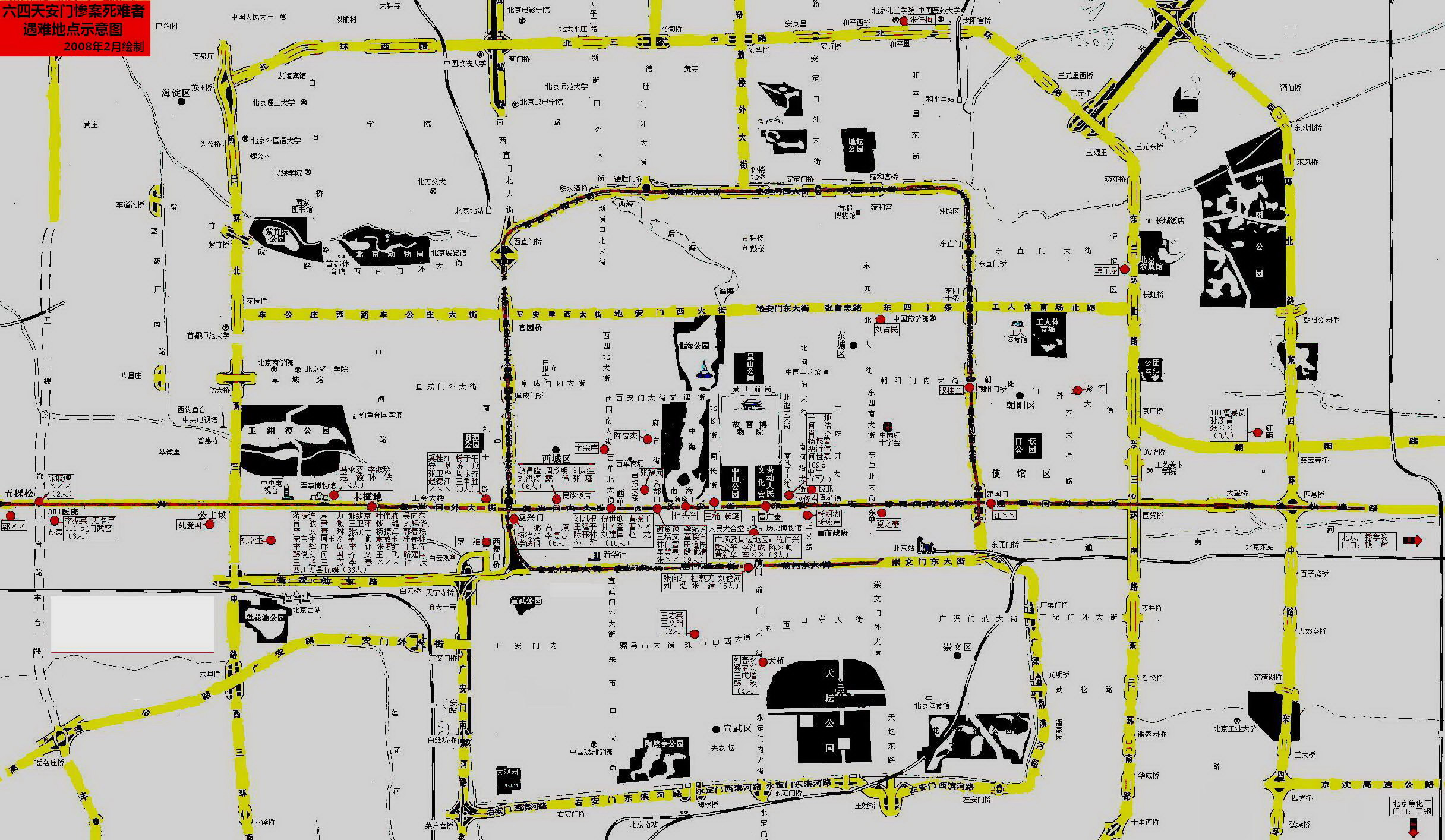
They were also able to identify the exact locations for 134 deaths. At the 19th anniversary of the tragedy, they published detailed maps showing where they had fallen (the map is annotated in Chinese):

Map of the Fallen Victims

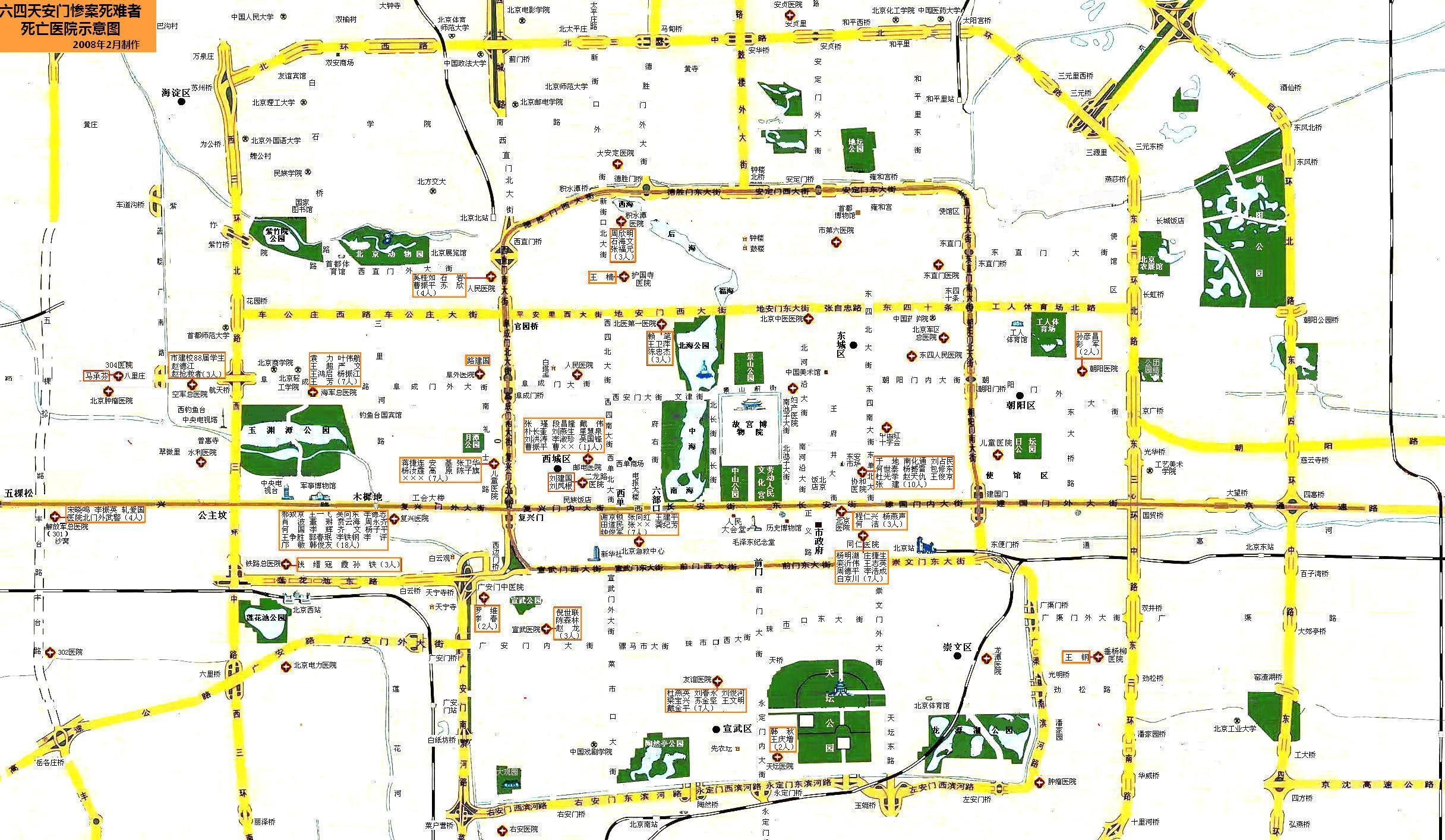
An accompanying map shows the hospitals where the dead were collected:

Map of Hospitals

The first map clearly indicated that the worst fighting happened along the Chang'an Avenue to the west of the Square, where the Beijing residents had put up the most stingiest resistance and where the troops showed the worst violence. Entering the city from the west, the troops killed 2 people in the outskirt, 4 in front of the Military Museum, 36 at the Muxudi intersection, 10 before Fuxinmen, and 5 at Fuxinmen intersection. Continuing inside downtown, they killed 6 near the Peoples Hotel, 10 at Xidan, and 9 at Liubukou. Most of the 9 at Liubukou, however, were killed after the troops had encircled Tiananmen Square and students had withdrawn. In a nightmarish maneuver, an armed personnel carrier charged into crowed and mauled over many on bikes and foot.

In all, more than 80 people perished along the west Chang'an Avenue. In contrast, there were only 6 confirmed deaths in and around the Square itself.

The list of 189 confirmed by Tiananmen Mothers is certainly an incomplete one. It also did not include deaths within the military troop. But among the various numbers that had been reported in the media, it might be the one closer to reality.

Tuesday, May 27, 2008

Tiananmen Mothers Have Their Own Web Site

Just in time for the coming 19th anniversary of the Tiananmen Massacre, the Tiananmen Mothers finally have their own web presence at:

http://www.tiananmenmother.org/

The web site is constructed and maintained by a group of anonymous volunteers. It has an ambitious plan as an archival and forum site. Most of the contents has yet to be added. Right now, the site contains the history of Tiananmen Mothers as a group, as well as a list of 188 names they had verified to be the victims of the massacre.

All the contents are in Chinese, for now. There is a link for English language, but no content is available yet.

Saturday, May 17, 2008

NYT Archive 1989: Zhao Ziyang's Disclosure

On May 17, 1989, New York Times continued its coverage of the Sino-Soviet summit, focusing on Gorbachev's talks with Premier Li Peng and General Secretary Zhao Ziyang. It was not until the last three paragraph of the lengthy report did NYT mention "mysterious remarks" made by Zhao Ziyang:
Some of the more mysterious remarks made in the meetings today came when Mr. Zhao launched into a major defense of Mr. Deng and stressed his importance to the nation. The comments, which were repeated on China's television news program to guarantee a wide audience, may have been intended as a response to growing criticism of Mr. Deng and to accompanying suggestions that he should retire from public life.
Mr. Zhao also mentioned a previously undisclosed resolution of the Central Committee calling for Mr. Deng's guidance in dealing with most important issues. There have been widespread rumors here that Mr. Deng may retire after Mr. Gorbachev's visit ends, and Mr. Zhao's remarks could be seen either as a denial of the rumors or as a confirmation of them by giving Mr. Deng praise before he retires.
In a rare admission of the disaffection amoung Chinese youth, Mr. Zhao also said, ''Some people, especially young people, frequently raise doubts about the superiority of socialism.''
This disclosure, while appeared to be made in passing, was a critical turning-point of the 1989 movement. Rumor had it that Deng Xiaoping's daughter immediately called Zhao Ziyang's office accusing him for "selling out Old Deng". The next day, Yan Jiaqi, an adviser of Zhao Ziyang's led a group of intellectuals with a harsh statement targeting Deng Xiaoping as the "last emperor". From then on, the movement turned on Deng Xiaoping himself.

But first thing first. NYT appeared to be more impressed with Li Peng than Zhao Ziyang in their respective meetings with Gorbachev:
The Chinese were more reticent in discussing how normalization might be achieved, but they were happy to discuss their ideas about democracy. The most remarkable statements came from Prime Minister Li Peng, a target of the student demonstrators because of his previous wariness about rapid political and economic liberalization.
''We don't think that capitalist countries have a monopoly on freedom, democracy and human rights,'' Mr. Li said today in his meeting with Mr. Gorbachev. ''People in socialist countries should also enjoy freedom, democracy and human rights. China is prepared to improve these aspects of its political reform.''
Mr. Li also said China had ''taken note of the new thinking'' that Mr. Gorbachev has fostered in the Soviet Union, in what appeared to be a signal of China's interest in following the Soviet example in some areas.
Prime Minister Li's remarks appeared to represent the first time that a Chinese leader has mentioned respect for ''human rights'' as a goal for the nation. Until an article in the official People's Daily on Friday, which quoted unidentified scholars as calling for human rights, the term was used dismissively, as a bourgeois concept that had little or no meaning in China.

The Chinese Communist Party leader, Zhao Ziyang, also called for more openness - it was his aide, Bao Tong, who arranged for publication of the People's Daily article, party officials said - but his comments were slightly less forceful and less surprising because he has long been associated with a policy of greater liberalization.
On the other hand, just three weeks ago Mr. Li reportedly was involved in plans for an abortive crackdown on the democracy movement, and he said early last month that China would not copy Soviet political reforms.
While students and residents in Tiananmen Square were welcoming Mr. Gorbachev as a symbol of political reform, Gorbachev himself was less impressed:
''As a great political reformer, we urge Mikhail Gorbachev to talk to the Government on our behalf, for humanitarian reasons,'' Wang Dan, a student leader from Beijing University, said at a news conference today.
Mr. Gorbachev, walking on eggs to seal his historic raprochement with China, has avoided contact with the students. Today, after inviting senior Soviet journalists to brief him on the unrest in Beijing, he firmly distanced himself from his admirers. He consoled his Chinese counterparts that in the Soviet Union, ''We have our hotheads, too.''

After making his fateful disclosure to Mr. Gorbachev and the public, Zhao Ziyang tried to reach out to the students at night:
Late tonight, Mr. Zhao sent a message to the students calling on them to end their hunger strike and - in a major concession - declared that the highest levels of the Government and Communist Party ''affirmed the students' patriotic spirit in calling for democracy and law, opposing corruption and striving to further reform.''
The written message, which Mr. Zhao said represented all five members of the standing committee of the Politburo, amounted to a retreat from the party's previous position that the demonstrators were trying to cause trouble and sabotage the economy. Mr. Zhao also promised that the authorities would not punish the students after calm was restored. Biggest Protest of Year
It was not clear what effect the message would have on the democracy movement, which has been gaining momentum in the last few days.

In fact, this statement of his did not receive any real attention at all.

Last but not least, the last paragraph of Sheryl WuDunn's report was a breif quote from Professor Jiang Peikun (蒋培坤):

Jiang Peikun, a 54-year-old philosophy professor at People's University, said: ''We can no longer tolerate the Government. The students are bleeding over there. We will continue to support them until they win.''
Half month later, Professor Jiang's youngest son, then a high schooler, would be killed during the massacre. His wife, Ding Zilin, eventually became the leader of a group known as Tiananmen Mothers.

Friday, May 9, 2008

Mother's Day In Tiananmen Square

The Amnesty International UK is calling for people to send a mother's day card to the Tiananmen Mothers. You can enter your card here and they promise to deliver it to the Tiananmen Mothers by mother's day this Sunday.

Mother's day is not really observed in China. But as many other western customs, it has gained more and more popularity in recent years.

Monday, March 3, 2008

The Political Spring Season in Beijing

It's March, which means a few political activities will be going on in Beijing:
  1. The annual sessions of the National People's Congress and the Chinese People's Political Consultative Conference, known simply as the "Two Meetings" (两会), are in town. Security will be tight.
  2. After two weeks of hyperbole surrounding the meetings, there will not be any significant decisions made, especially in the year of Olympics
  3. But we will be entertained by pictures of many delegates nodding off during the sessions.
  4. Tiananmen Mothers petition to probe the Tiananmen Massacre.
It's been eleven years, but they haven't given up.

In the dark night of June 3, 1989, with gunshots heard and flares seen in the dark sky, Professor Ding Zilin (丁子霖) thought she had finally managed to lock up her restless son in their bathroom. But the seventeen year old high schooler outsmarted his parents. He climbed out of a window and headed to the streets. He was shot near MuXiDi (木樨地), at the western skirt of Beijing where the most fighting and death had taken place that night.

Since then, under tremendous pressure and constant harassment by the government, Ding organized and led the loosely-knit organization known as the Tiananmen Mothers, consisting parents (yes, mostly mothers) of victims who had died during the massacre. They painstakingly collected and documented 155 cases of death. They also helped to channel humanitarian funds from abroad to the victims' families.

But year after year, they have also petitioned the "Two Meetings" for a dialog and reconciliation. They have yet to receive a response.